Showing posts with label Chinese New Year. Show all posts

February 8, 2013

Dai Fat Go--Cakes for a Prosperous New Year

Most of our mothers and grandmothers have literally perfected a few to several dozen specialty Chinese dishes; but most do very little home baking.  This is not to say that they are immune to the wonderful smells wafting out of the doors of the Chinese bakeries on Stockton, Clement, or Irving Streets--the don tats (egg custard tarts), char siu baos (steamed pork buns), and the gai mei baos (cocktail buns).  But let's just say that my mother-in-law's oven is most popularly used to store over-sized pots and pans--not for baking.

It's nice to have a big wok with a lid for steaming.  It will fit a 6 muffin tin.
So it was fun to see how her eyes lit up when she realized she could make a simple cake using equivalent amounts of just four simple ingredients, after a friend gave her the recipe.  The "fat" in the name of the little cakes means prosperity [think: gung hay fat choy], so, they are typically made around Chinese New Year.  This year, the first day of the year of the snake lands on Sunday, February 10.

I rivaled my mother-in-law's excitement with the realization that the recipe is naturally egg and dairy free, two of the main food allergens in our household. My mother-in-law has been making the cakes all week, and the kids have been enjoying fresh muffins for breakfast.  I've found they go especially well with my afternoon cup of coffee.  They are really moist, spongy, and slightly sweet.

What gives these cakes their pretty flower shape is that they are steamed, not baked, so I guess my mother-in-law will be keeping her pots and pans tucked safely away in her oven for the time being.  Steaming muffins was a first for both of us.

Before I give you the recipe, you should know a few things about my seldom-baking mother-in-law. When someone says to add 1 cup of something, she uses a dry measuring cup, not a liquid one.  And when someone says to add brown sugar, packing the sugar is optional.  So even though the original recipe said to add one cup of brown sugar, packed it was equivalent to 3/4 of a cup.  This recipe couldn't be easier.

Logan had a blast helping his grandmother with the cakes.  Way too much fun for a sick day.

Dai Fa Go--Big Prosperous Cake  (No Egg or Dairy)

1 cup flour

1 cup water

1 cup dark brown sugar, unpacked (or about 3/4 cup dark brown sugar, packed)

1 cup Bisquick

Stir the ingredients together, pour into lined muffin pan, and steam on a plate in a large pan or wok covered for 15 minutes.

Makes 6-8 little cakes

A big prosperous Chinese New Year to all of out Get Allergy Wise families!  Time to go clean the house...

January 23, 2012

Chinese New Year: Photos and Neen Gow

Gung Hay Fat Choy!  Happy New Year and welcome to the Year of the Dragon!


Yesterday was a really busy day for us, not only because it was Chinese New Year's eve but, truth be told, there was a important football playoff game!  So between cleaning up the house and preparing a special dinner, I was also designing fun game day munchies (more on that next week) and keeping our eye on a close match.  I figured our family would be so full of snacks from the late afternoon game that I decided to only prepared a couple of dishes for our New Year's meal.  (Good call.  We had TONS of leftovers.)  I kept it simple and stuck to lettuce cups and glass noodles, main dishes that worked well for us last year.


I did make one new thing this year, New Year's Cake (called nian gao in the dominant Mandarin dialect, or neen gow in Cantonese, which is Sarah's and my family's dialect).  Neen gow is made as an offering to the Kitchen God, who observes your behavior and helps determine if you have a prosperous new year.  Another explanation on why we offer this treat:  the sticky cake will keep the Kitchen God's mouth so occupied, he will be unable to report back on anything at all (bad or good)!

Neen gow is not your ordinary cake.  It uses glutinous rice flour and steam to create a mochi-like, gummy cake.  (For those unfamiliar with traditional Chinese desserts, they are typically less sweet than Western desserts and often use beans or rice.)

Making neen gow was really easy!  I bought my ingredients at a local Asian supermarket.  The rice flour should be easy to find there in most Asian markets -- make sure it's "glutinous" because you'll find out that there are quite a few different options in rice flours.  If you cannot find brown sugar pieces, you can easily substitute the readily available regular brown sugar.  In fact, it might be easier.  It was time-consuming to try to break down the hard pieces in the liquid.  The water-coconut milk combination I used was delicious but you can also replace the water with more coconut milk for an even richer flavor.


For the steaming, I used a huge stockpot and a metal wire stand to elevate my ramekins over one inch of water.
The neen gow mixture before steaming
While people usually prepare a big feast the night before Lunar New Year begins, there are fifteen days of celebrating.  Let the long party continue with your own new year's cake!

Steamed New Year's Cake (Nian Gao or Neen Gow)

1 cup full-fat coconut milk
1 cup water
16 oz. bag of glutinous rice flour
1 package of brown sugar pieces or 2 cups brown sugar (I used 4 of the 5 pieces in the package)
Dried fruit, sesame seeds (optional)
  1. Heat coconut milk and water over stove or in the microwave.  Add brown sugar.
  2. Dissolve brown sugar in the liquid making sure the completely break up any hard pieces.  This took a bit of time but after a while, the pieces absorbed enough liquid so that I could break them up with a potato masher!
  3. Remove pan from heat.  Slow stir or whisk in glutinous rice flour into water-coconut-sugar mixture.  
  4. Once ingredients are well combined, pour into a well-greased 8-inch pan or six greased 4-inch ramekins.  Add a dried piece of fruit (a pitted plum is common) in the center of pan if desired.
  5. Steam mixture over medium heat for 1 to 1.5 hours or until neen gow starts to pull away from the sides of its container.  Remove from heat and let cool.
  6. Drizzle with sesame seeds if you desire.  For easier cutting, refrigerate before serving.  Slice before serving.

The finished product after 1.5 hours of steaming
We hope the Year of the Dragon has started off well for your family.  Enjoy the renewed hope and remember, no sweeping today or you'll sweep away your good luck.  Woo hoo!  A break from cleaning!

A pre-New Year's trim, new red car shirt, and lucky money --  Callan had a great start to the Year of the Dragon!

January 18, 2012

Year of the Dragon Checklist

Although I grew up in San Francisco's Chinatown, Chinese New Year was little more than saying "Gung Hay Faat Choy" to our friends and family, receiving red envelopes filled with money, and counting up our spoils at the end of the day.  We didn't know to receive them with two hands.  We didn't know how to say "thank you" in Chinese.  It was bad enough we didn't speak or understand the language, but not knowing or practicing the customs was even worse. 

So when I met and married my husband, whose family is much more traditional than mine, I had the task of learning, understanding, and finally embracing the traditions associated with Chinese New Year, so that my children would also learn to make the customs their own.

It has been a several year-long journey for me, but this year I've finally become proactive and intentional about preparing the family for a happy and prosperous year of the dragon.  You see, in my interpretation of the customs, there are several foods you can eat and things that you can do which symbolize luck, and one does as much as one can to bring in the new year.

Here is our Chinese New Year Check List:

1. Clean the house--Sweep out the old, in with the new.  Don't clean on New Year's or you'll risk sweeping up good luck.  (Oh, how this one haunts me!  But I'm determined...)

2. Get haircuts--Same concept--don't get your haircut on New Year's or you risk cutting off some luck.

3. Buy new red clothes  for the family.  Now this is definitely something I've got covered (shopping, anyone?).  And with leftover holiday merchandise left on racks, and Valentine's Day around the corner, shelves are stocked with red clothes.  Everyone sports their new threads on New Year's Day.

Addi is happy to try on her new red dress!
  4.  Prepare red envelopes with lucky money to give out to family and friends' children.  Children are taught to say "Gung hay faat choy" or other phrase wishing luck, happiness, health, etc. and are given two envelopes from each couple, one from each person.  The envelopes can be filled with any denomination of money, but when considering how much to fill each envelope, note that 4's are considered unlucky and 8's are considered especially lucky.


5. Select orange, round tangerines with stems for freshness and beauty to create a display in a bowl.  My mother-in-law will also add a pomelo and some red envelopes to her bowl. 


If you lack space or just want a fun craft project for little ones, try making an orange bowl collage with various textured paper. 


6. Try a few Chinese New Year recipes.  There are many foods considered lucky because their names are homonyms for various words or phrases for wealth, luck, or happiness.

I will leave you with one recipe today, and post a few more later on in the week.  Irene posted a link to a lettuce cups recipe last year, and I had to tap into my greatest resource (my mother-in-law) to get some advice about making her kid and allergy-friendly version of my childhood favorite, traditionally made with oysters.

My Mother-in-Law's Lettuce Cups for Kids (Egg, Dairy, Nut-free; can be made soy and wheat free by eliminating the hoisin sauce)

Eat lettuce cups for good fortune


Ingredients:

6-8 oz. of Chicken Breast (alternatively, use ground chicken)
2 Aidell's Chicken Apple Sausages (or use Chinese sausages--"lop cheung")
1 small can of Water Chestnuts (or use Jicama)
1 oz. of Dried Black Fungus*, soaked for at least an hour in a bowl of water
5-6 Dried Chinese Black Mushrooms, soaked for at least an hour in a bowl of water
1 head of Iceberg Lettuce
Hoisin Sauce* (plum sauce--contains wheat and soy)
2 T. Oil
Garlic Powder, Salt, & Pepper to taste (about a tsp. of each)
1 tsp. Cornstarch
1 tsp. Sesame Oil*

(*Optional ingredients)

1. Dice the chicken breast.


2. In a small bowl, add about a tablespoon of oil, garlic powder, salt, pepper, cornstarch, and sesame oil to the diced chicken and let sit while you dice the sausage, water chestnuts, dried black fungus, and black mushrooms.


Diced black fungus


3. Peel, wash, and dry the lettuce leaves and set aside.  You want to try to keep them whole and intact.
4. Add 1-2 tablespoons of oil to a pan and stirfry the chicken until cooked through.  Add sausages, water chestnuts, fungus, and mushrooms until heated through.  Remove from heat.
5. Serve immediately by scooping chicken mixture into lettuce cups and drizzling with hoisin sauce.


The boys got this version because they're not big mushroom fans
Get to your Asian market today, because although they may stay open for Thanksgiving and Christmas, they'll all be closed for Chinese New Year.  Happy shopping!

January 16, 2012

Dan Dan Noodles: peanut-free goodness

Happy, happy birthday to Martin Luther King, Jr.  Hope your families are taking the time to reflect upon his legacy, his beliefs, and what you are doing to serve others.

Truth be told, Sarah and I are still in recovery mode from the holidays, the winter cold/flu season, and the reboot of the usual hustle &bustle of stay-at-home life with kids and their many activities.  Both of us have been working on recipes, meal ideas, and crafts for the blog but have had a bit of a time/energy challenge with transferring it over to the blog for our fabulous readers.

As we talked at a birthday party on Saturday, Sarah reminded me that Chinese New Year is just around the corner.  Yikes!  (Monday, January 23rd to be exact.)  For those of you that aren't familiar, Chinese New Year or Lunar New Year goes by the lunar calendar so the date is different from year to year.  Sometimes it's in late January and other years it's as late as President's Day.  This year it has truly crept up on me but I'm more than happy to dive into some Chinese cooking.

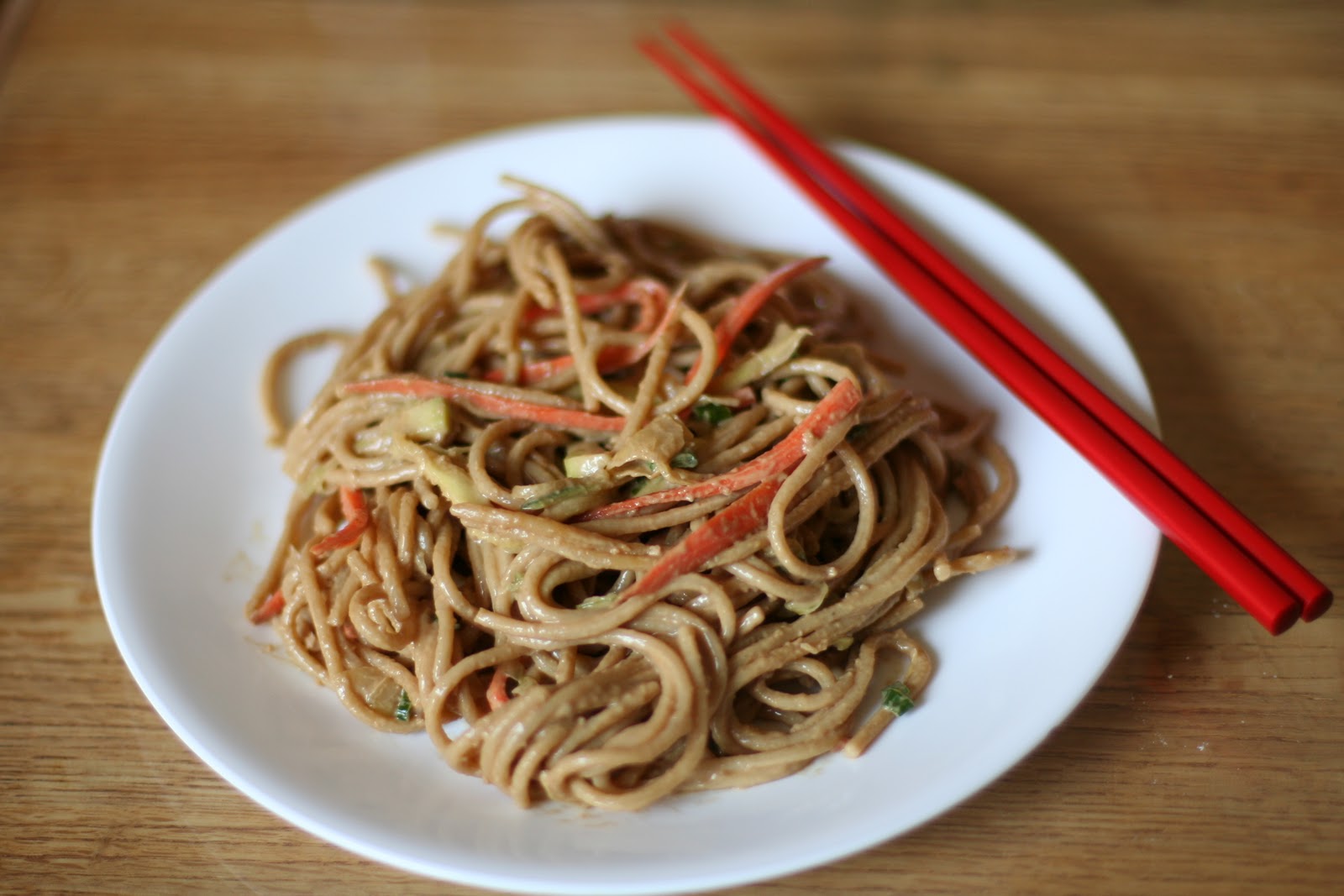
We shared some allergy-friendly traditional lunar new year dishes last year.   In preparation for this year's meal, I've been playing around with some noodle dishes.  A popular Chinese noodle dish is dan dan noodles.  Served cold and traditionally made with peanuts and Chinese noodles, it's a good target for making allergy-friendly.  It makes for an easy meal that is full of flavor thanks to the loads of fresh garlic and ginger.  Because it's a cold dish, parts or the whole dish can be prepared ahead of time and stored in the refrigerator until you're ready to put it all together.

There are a lot of different ways to make dan dan noodles some of which are completely free of vegetables.  It would make me feel a little too guilty to eat a whole bowl of the stuff without some plant goodness so mine calls for fresh carrots, zucchini or cucumber, and cabbage.  Feel free to experiment with different fresh, steamed, or stir-fried veggies or use the more traditional pickled cabbage (canned or jarred) that you can find in Asian grocery stores.  Add more minced garlic it you like.  Be really conservative with the sambal oelek if you're little ones or you aren't big fans of spicy food.  A little of the stuff already goes a long way!


Dan Dan Noodles
Adapted from Alton Brown's recipe on the Food Network

8 to 12 oz. of your favorite safe spaghetti, ramen, or other noodle/pasta (I've used fresh Chinese noodles and TJ's organic whole wheat spaghetti.)

1/4 to 1/2 head of cabbage. thinly chopped (In a pinch?  Trader Joe's sells already shredded cabbage.) 


For the sauce:
1/3 cup sunflower seed butter 
4-6 cloves garlic, minced
2 Tbsp freshly grated ginger
2 Tbsp soy sauce (Use gluten-free soy sauce or tamari if you are avoiding wheat or gluten) 
1 Tbsp brown sugar
1 Tbsp sesame oil
1 Tbsp rice wine vinegar
1/4 cup vegetable or chicken broth
chili paste (sambal oelek) to taste

1 or 2 carrots, peeled and julienned
1 cucumber or zucchini (I used the latter), julienned
2 green onions, finely chopped


  1. Boil noodles accordingly to package directions.  Drain and rinse, and set aside.
  2. Steam cabbage until wilted.  You can do this over the stove.  Alternatively, you can do steam with your microwave by putting the cabbage and a couple tablespoons of water in a covered bowl or deep dish.  I've done both methods and check every few minutes.  It usually takes less than 10 minutes.
  3. Drain cabbage and set aside.
  4. Mix sauce ingredients together.  
  5. Toss cooled noodles and cabbage with sauce mixture until evenly coated.  Add julienne vegetables and green onions and re-toss until well combined.
  6. For a spicy kick, add a little sambal oelek and mix well.  Taste and stir more in until you get your desired heat.
  7. Refrigerate until you are ready to serve.


February 18, 2011

Olivia's Fried Rice

I made fried rice for Logan's class for their Chinese New Year celebration, and even though it bears only a slight resemblance to anything I might call "Chinese" (ok I'm so putting my Chinese ancestors to shame), I thought I would share this meal idea.  In fact, most people I know only make fried rice when they have some leftover rice in their rice cookers, and a few small portions of meat, fish, tofu, or seafood and veggies in their fridge. 

One of Logan's classmates, Olivia, requested this dish after trying it at school, so I'm going to post what I did for the class that day, and hopefully you'll get inspired and make your very own (WAY better) version. 

The key to a good fried rice is using leftover rice from the night before.  If you don't have that, make your rice, and then uncover it so it can dry out a little before frying it.  Basically add oil to a heated pan, add the meat, fish, or other protein, veggies, and rice, and cook together, stirring occasionally.  Try the following recipe for a super easy and allergy-friendly meal.

(I added carrots in this batch but not in the one for Logan's class, so I omitted them from the recipe)
Olivia's Fried Rice  (WARNING: contains SOY)

Ingredients:

Cooked rice (a little goes a long way, depending on how many "fillers" you have to throw in. For our family of five, I would probably start with 2 cups or so of uncooked rice)

2 Aidells chicken sausages (my kids love the mango and the chicken apple), diced

Frozen peas and corn (1-2 cups total)

Oil (we use olive oil for all of our cooking)

any Asian style sauce that your family enjoys, like teriyaki, soy, oyster, vegetarian oyster, etc., to taste (Alternately, you can marinate your meat or fish before cooking.  I often make the rice without any sauce when using the Aidell's sausages--they've got lots of flavor on their own.)

Directions:

1.Cook sausage over medium heat in a pan with oil until heated through. 
2. Add cooked rice and spread evenly around the pan.  My kids like a few crispier parts, so I usually just let it cook for several minutes (5-10 min.), while stirring ocassionally.  The rice will absorb the flavor from the meat.
3. While the rice is cooking in the pan, microwave the peas and corn in a bowl until they're warm (probably about 2 minutes or so).
4. Add the cooked peas and corn and the sauce if you're using it, and let the rice mixture cook for a few more minutes. 

Experiment with this dish.  You'll find it's a fast go-to recipe for lunch or dinner.

February 2, 2011

Chinese New Year

This year we ring in 4709, the Year of the Rabbit, on February 3rd. The Lunar New Year is celebrated by Chinese descendants and other Asian cultures throughout the world. In China, it’s two whole weeks of celebrating! Rich with symbolism and delicious foods, it is a great holiday to introduce to your family. It is also flexible for interpretation, which makes it great for allergy-affected families and cooks of all skill levels!
The hallmark of this holiday is a reunion dinner on the eve of the new year. The foods chosen represent wishes of good health and fortune. Whole steamed fish and chicken, and green stocky vegetables are common dishes served. Here are several food ideas to help you ring in an auspicious, allergy-free year of your own!


Ling Ling Potstickers

Ling Ling Potstickers (Allergy-free: Milk, Egg, Shellfish, Fish, Egg, Tree nuts, Peanuts)

Where to Buy: Safeway, Costco

On the go:
I'm assuming that Safeway carries these at most of their stores since I've found these while traveling to Truckee and to the L.A. area at their stores (Where else have you seen them?).
And, they seem to disappear when they're packed in the school lunchbox, so they're either still decent warmish or my kid just loves these that much.

Ling Ling frozen potstickers are a staple at our house (NOTE: NOT for the soy or wheat allergic!).  We have them so often that while they're still cooking, a few hungry children will always exclaim, "Mmm...potstickers!"  They have no added MSG, are hearty enough for a meal, and are a fan favorite for the entire family.  Plus, having this lovely meal means I only need to wash one pan when dinner's done (bonus!). 

To prepare, I follow the preferred method on the back of the package:
1. Add 2 Tbsp. of cooking oil to 12-inch non-stick skillet.
2. Add frozen potstickers in a single layer and cook for 1 minute on medium-high.  To keep from sticking, do NOT move potstickers.
3. Add 1 cup warm water.
4. Cover and cook for 8 minutes or until water has evaporated.
5. Uncover, cook 1 minute or until golden brown.


They come out hot and steamy, crispy and chewy...de-lish!  A fast, easy, and readily available option for introducing Chinese food into your repertoire, just in time for Chinese New Year!