Showing posts with label personal stories. Show all posts

August 26, 2013

It's A Small World

Tristan had three allergic reactions during our three week summer getaway.  (Don't worry, he was treated and fine each time).  We learned the hard way to look at every label every time and to take the "shared equipment" disclaimers seriously. Very seriously.  Every time.  I must admit we've been loose about the disclaimers in the past.

In our defense, since Tristan just turned nine, we have probably read 14,600 labels = (365 days x 5 labels x 8 years)!  Just for him just to make sure that what we were about to give him wouldn't make him sick.  And that's a conservative estimate, and includes labels for new foods as well as labels for foods we regularly eat.

Happy Birthday to our big guy!
So now that we are being overly cautious about ingredient labels and cross contamination, I feel like our world just got a lot smaller.  Our safe product world, that is.  I never wanted to be the kind of mom to stress and fret every day about how few foods are available to my son, but the fact is, this new development has gotten me to a heightened state of awareness.  Meaning my stress level went through the roof.

There is enough worry associated with the first week of school: new teachers, new kids, new classrooms.  On day 1, Tristan found out that his teacher has a cat.  Tristan is severely allergic to cats.  Oh yeah, and he was sneezing all day with a runny nose, and is now taking a daily antihistamine.  And thus is the life of an allergic child.  But I digress...

What I wanted to say was that my discovery of homemade bread and my mother-in-law's breadmaker actually helped to save my sanity.  Yes, I just said my mother-in-law just made me more sane.

Bread and other bakery items so commonly are made on shared equipment with several ingredients that my son is allergic to (egg, dairy, nuts, etc.), so I decided to try my hand at homemade bread.  We were on vacation and had no machine, but I tried it out and the bread was incredible, hot and fresh.  It was likely the best bread my son has ever tasted, as we are usually forced to buy from a short list of breads that are dairy-free.

The kids loved making the bread.  Definitely a great activity for a rainy day.
I googled "easy vegan bread" and found the recipe for the Easiest Simplest Vegan Bread Ever. Obviously, I made that one, and am officially experiencing a homemade vegan bread obsession. And I must say if you find a breadmaker with a timer feature (which I'm sure they all have by now), there's nothing like the smell of hot bread to wake up three sleepyheads during their first week of school (and one sleepy mommy who hasn't yet had her coffee).

So even though my world got smaller this summer, a few things opened up for our family in our food world.  Managing my children's food allergies has always been a journey--this is just another turn in the road.

June 25, 2013

Weekend Getaways: Food 101 for the Family with Food Allergies

For some, summer means travel.  I relish the lazy days close to home myself, but if we had the option to travel all summer long, I might very well consider it.  Unfortunately, for a food allergy family, traveling is a challenge with an enormous amount of planning involved.


With a severely food allergic child, I feel less and less comfortable eating out, especially when we're far from home.  I think I've got the Epinephrine to ER thing down pat when we're at home, but being on vacation with an allergic reaction is a different story all together.

So I try very hard to limit our restaurant eating and do as much preparing and cooking as I can.  We will be away this weekend for a rare mini getaway with the family, and although we will be within an hour from home, I still have a lot of planning to do.  Some tips to make the getaway more like a vacation and hopefully, less stressful:

1. If you can, book a hotel with a refrigerator at the very least, and for longer trips, some form of a kitchen or microwave is essential.  If there's no microwave in the room, there may be one available for use, like in the lobby.

2. Seek out the markets near your hotel before you go, and plan on making a few trips with a list of easy, allergy-friendly, low maintenance food options in hand.  Some forethought saves you time in the long run.

3. If there is a stove available, bring your own pots/pans and cooking utensils.  This cuts out the mystery and puts some of your cross-contamination worries at ease.

4.  Bring paper goods and disposable eating utensils.  No one likes to wash dishes on vacation, but this is especially important if all you have is a fridge.  An added bonus: kids can eat by the pool and not skip a beat!

5.  Bring drinks or water bottles and lots (and lots) of non-perishable snacks to pack for day trips, have by the pool, or satisfy a craving.  Some of our favorites are safe granola or breakfast bars, crackers, popcorn, fruit or fruit and gel cups (like Dole Fruit and Gel Cups), fruit leathers, seeds, and dried seaweed.

If you're a seasoned food allergy mama you likely already follow these guidelines religiously.  For those of you who might be starting out, know that you CAN have fun while on vacation.  And yes, we were the ones with the 8 grocery bags filled with food upon check-in, but we were also the ones who spent a fabulous 87 degree day by the pool.

Wishing you safe and happy travels this summer!

April 23, 2013

Traveling with food allergies: always an adventure!


Hanging out with Mater in Cars Land
I used to enjoy traveling.

Don't get me wrong.  I still love poring over friends' photo albums.  I reminisce with my husband about taking a Thai cooking class and finding the cheapest massage ever while exploring the streets of Chiang Mai.  And I still aspire to see more of Asia, more of Europe, and the other three continents I have yet to explore.

Once my eldest son, Ryken, was born I knew it would be a lot harder to travel with the adventurous attitude of my kidless years.  Kids need routines, not to mention good sleep and flexibility, and the confines of planes, hotels, and restaurants can throw off kids.

Little did I know that having kids with food allergies would not only make travel MUCH harder but it would make travel almost completely unattractive to me.  Now, the beautiful images of pristine blue waters and white sands are marred by anxieties over a lack of safe restaurant choices.  Ziplining through lush rainforests and sleeping among trees have been ruled out because you certainly won't find a fully equipped hotel suite with kitchen up a tree in a jungle and who knows where the nearest hospital will be.  Visiting the grandparents in China has been put off indefinitely because we do not trust that we will get clear answers on what is in our food and cross-contamination is way too risky in a country that doesn't have or deal regularly with food allergies like our own.

Despite my legitimate concerns over travel, it is sometimes necessary for us to travel.  And we do want our kids to experience fun places and activities that their peers do, too.  My husband is great about overriding my anxieties and insisting that we take advantage of spring break and take a family trip.  Since we had such a fun time last year in southern California, we decided to plan a very similar trip with days in Disneyland's California Adventure, Legoland, and the sunny, beachy areas of San Diego.

We stayed with family for the first couple of days and then took up residence at Homewood Suites (very close to Legoland) which offers accommodations with a small kitchen.  A kitchen is the #1 must-have for all of our trips.  Our #2 must-have seems to be a Trader Joe's within short driving distance.  Seriously, we ate more Trader Joe's ready-made food than we have ever eaten before.  I can say with full confidence that the kids are as sick of turkey club wraps as my husband is of eggplant wraps.  (I, on the other hand, could always go for a lentil wrap!)

Sharing a sofa bed and indulging in Cartoon Network
were other big pluses at Homewood Suites. 
Even though we had access to a kitchen, I did very little "real" cooking during on our vacation.  It's more like I use hotel kitchens for the refrigerator to store sandwiches and ice packs that we take into amusement parks for our safe lunches.   And a microwave is handy to throw together mostly already-prepared (and previously-vetted) into some semblance of a meal.  It's too hard for me to prepare any of our usual meals without a fully stocked kitchen.  And I often have no energy to spend a couple hours cooking after a full day of exploring, driving, or having fun in the sun.  Anyway, shouldn't I get to relax a little, too?  It's a family vacation, after all.
My husband's great.  He can even make grocery runs
(and there were many) good fun for the kids!

We feel very comfortable having most of our trip food come from Trader Joe's because it's familiar and safe.  However, we did try to break up the monotony.  We ate at five different restaurants during our week-long road trip, three of which we had safely eaten at before which.  Out of the five restaurants, we had problematic experiences at two of them.  And guess what?  One of them was a restaurant we have frequented many times before and the second was a restaurant chain highly recommended by many food-allergic eaters!

The first restaurant was actually our favorite local Thai spot.  We had ordered takeout the night before our drive to Southern California.  And as usual, I had spoken to one of the servers and explained the kids' food allergies which the server quickly recognized -- we must be the only "regulars" with milk/peanut/tree nut allergies.  We ordered our usual pad see ew noodle dishes with steamed tofu (never deep-fried in case frying oil is reused and contaminated with milk and nut particles).  This is a dish we've eaten over and over again without any problems.  And the kids again had no problem with the noodles.  A day later, while spooning out some leftovers for Ryken and me, imagine my panic when I discovered HALF OF A PEANUT in one of our untouched boxes of pad see ew.

My heart almost leapt out of my chest when I spotted it.

Sadly I think it might be a really long time before Ryken is comfortable eating Thai food from a restaurant again.

(Side note: Many people have questioned how I can feel comfortable ordering Thai food when a couple of their most popular dishes are made with peanuts.  The truth is we speak to the servers about how peanuts are used -- are they cooked in the pan, any peanut oil used, is peanut sauce placed on the side, are chopped peanuts only used for garnishing finished dishes?--  we carry our Allergy Translation cards, and we get a sense for how thorough the servers are in speaking with their chefs about our needs.  We have felt comfortable with this restaurant because the chef and servers know us by face.  But this accident has made me rethink restaurant-made Thai food.  The threat of an errant peanut making its way in to a cooking pan is too risky.  Plus, my wise Ryken has declared that he never wants to eat in a Thai restaurant again, the close-call clearly having an impact on him.)

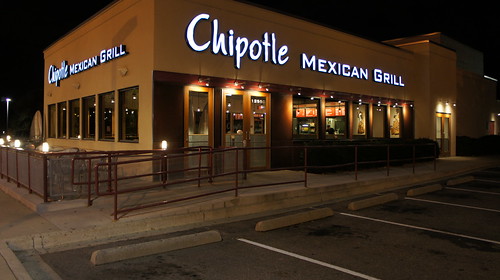
Exterior - Chipotle Mexican Grill
Photo taken by Aranami from his/her Flickr photostream

The second restaurant that we had problems with was Chipotle Mexican Grill.  The Chipotle chain has been touted as a good option for people with various food allergies.  The company's lists major allergens in each menu item on their website and proclaims that their food is completely egg-free, nut-free, shellfish-free and fish-free.  Dairy products are limited to the cheese and sour cream so, in theory, someone with a milk allergy could get a safe meal so long as proper care has been taken to prevent cross contamination.

We tried Chipotle as I had read a lot of positive reviews from other food allergy parents.  Sadly, it wasn't a good experience for us.  Ryken developed a stomach ache a few minutes into eating.  He claims he felt a little stomach ache before dinner but it was clear to us that his stomach ache intensified after he began eating.  We monitored his symptoms and kept our EpiPen Jr. packs close by while we rushed back to the hotel.  His stomach started feeling better after about half an hour from when we ate.  I can't say for certain what Ryken reacted to -- cross contamination of milk or maybe he has an undiagnosed allergy to a less common ingredient (maybe a spice) used in the cooking process?  All I know is that we had big hopes for being able to add another safe restaurant to our very short list but it was not meant to be.

I don't regret the decision to try eating out with the kids but I am very grateful the reactions were under control.  And despite those two incidents, we still had a fantastic time.  But I can't tell you the enormous sense of relief I felt to come back home -- forget sleeping in my own bed, I was relieved to cook our meals again in the safety of our milk-free, nut-free kitchen!   Phew.  I sure could use a vacation after the vacation.

Until we meet again, gorgeous San Diego beaches!

March 25, 2013

A Successful Marin Overnight

When Tristan left in the morning with his big duffle filled with sleeping bag, toiletries, and layering pieces--for which I had specific instructions lest he go out everyday in a t-shirt--I was in pieces.  There was never a doubt in my mind that we would make it happen, and figure out a way for him to be included in his class' first overnight stay.  I just hadn't anticipated how nerve-wracking it would be.  And little did I know how much of a learning and growing experience it would be, for the both of us.

Eighty third graders stayed two nights at the Point Bonita YMCA.  It is a clean facility, with separate boys' and girls' dorms.  Bunks are divided into several smaller rooms and one meeting room, and large bathrooms.  Their spacious dining hall includes a buffet and plenty of long cafeteria-style tables.  All the children were given an orientation about how the dining hall works, with an emphasis on composting and taking only what you can eat.  The food is mostly organically grown and healthful, with basic ingredients, which simplified things for us.  On top of it all, the meals were delicious.


So how does a multiple and severely allergic child eat in a dining hall in a camp-style setting?  With a lot of planning, foresight, and a bunch of faith thrown in for good measure.  Richard Holden at Point Bonita YMCA was a pleasure to work with.  We communicated via email, with a follow-up discussion with his chef when we got there.  Here are a few things that worked for us:

1.  I emailed Food Service Director Rich Holden well in advance of the trip.  We emailed back and forth until I came up with a modified menu for Tristan.  It would have been nice for these menus to have been posted in the kitchen upon our arrival, but Tristan brought two copies of the menu with him, both of which he ended up giving to the chefs for reference.  I made sure to introduce Tristan to the chef before the first meal.

Here is the dinner menu for day 1.  Rich was willing to do a modified menu, or a combination of a modified menu and supplements, depending on the food allergies. We needed to do minimal supplementation (just soy milk boxes and Oreos), as there was lots of variety.

Point Bonita Sample Dinner Menu

Pasta and Meat Sauce
or Vegetarian Pasta
Sauteed Vegetables
Dinner Roll, Salad Bar
Fresh Baked Cookies

Tristan ate a hearty meal of pasta with meat sauce and vegetables on day 1.  His food was either separately plated by the chef, or he was allowed to plate his food first to avoid cross contamination at the buffet.  We brought a stash of Oreos for dessert, and he ate those instead of their cookies.  Although I was very impressed by the kitchen's attempt to accomodate Tristan with allergy-friendly cookies, I decided against them after reading a "traces of dairy" warning on the package.

2.  Before the trip, I gave Tristan's third grade team a refresher on food allergies and Epi-Pens.  I used some of the materials from our Food Allergy Summit in NY (and later improved the presentation with a food allergy quiz).  Each teacher tried out a trainer pen, and I answered everyone's questions as best as I could.  We agreed that Tristan would carry his Epi-pen in his pack.  It was really valuable to reconnect with the teachers about the severity of Tristan's allergies.  During his stay, Tristan was grouped with the male teacher in the group for hiking and bunking.  Big thanks to Mr. H and the third grade team!

3.  On the advice of his allergist, Tristan brought Claritin to take nightly.  In an unfamiliar place with allergens all around, it was smart to have some antihistamine in his system.

4.  The naturalists were alerted of kids who had special needs or medications, so they were made aware of Tristan's allergies and medications in his pack.

5.  I tried to prep Tristan about managing his food allergies with a balance of trust and caution.  I needed him to trust that I had prearranged a safe menu for him, but I also warned him that adults could make mistakes, and that he needed to make sure he was getting what was on his menu.  I asked him to look at his copy before each meal, and make sure he knew what he was supposed to be eating.  I think that helped empower him and give him a sense of confidence.

6.  I packed safe granola bars in his pack, in case he wasn't comfortable with a meal, snack, or just got hungry.

When I went to pick Tristan up from school on day 3, he looked relieved to see me. In the car, he told me that he "just missed us so much."  I was so proud of him for having such courage and stamina to collect his worries and gain such a valuable experience.  Three days without him at home gave me a glimpse into the future, with a bit of worry, but a lot of optimism, too.


The day I was there, we hiked around and down to the beach, then back to the Y. The kids would approach the trail as a group, each with different responses and ways of coping.  Some would charge straight down the hill, without looking back.  A few would sidestep down, cautiously taking each step.  Others would look straight down, as not to brush against poison oak, or step into a hole.


My hope for Tristan is that he is cautious, but confident through life, and that he take the time to explore and take in his surroundings.  I hope that when he needs to, he will grab my hand for some extra support, and that he will let go when he's ready.  I may never be ready, but knowing that he will be is an awesome feeling.

January 31, 2013

Kissing-Induced Anaphylaxis?

She may have her first kiss a lot sooner than we want to admit.

OK, maybe you can't get anaphylaxis from kissing.  Or can you?

I consider myself far from having to worry about any of my kids being interested in kissing, as I'm sure just the thought of kissing a girl makes my 8-year-old son cringe.

"Hey Tristan, what do you think about kissing a girl?"

"It's weird."

"Remember that time that Ella kissed you?  You guys were around 3."

"Yeah, I didn't like that."

But one of these days, in the hopefully far but very really possibly near future, he will get curious.  And when that time comes, I want him to be armed with answers to any questions he might have about his food allergies and kissing.

In Mylan's recent study to understand some of the gaps in anaphylaxis awareness, where 300 families with food allergic children were surveyed:
  • One in 3 parents reported that their children had experienced a life threatening allergic reaction on Valentines Day
  • Less than half speak to their children about potential allergy risks they might face on Valentines Day, like kissing someone who has eaten something they're allergic to, or candy that may be passed out at school.
  • Less than half tell their teens to tell their dates that they have a life threatening food allergy.
  • Less than half remind their teens to bring their Epi-Pens with them before leaving the house.
Is this data at all surprising?  I don't really think so.  Conversations about dating, kissing, and risk-taking are hard enough.  We all hope that when it's time to have these difficult talks, we'll be courageous enough to speak, and our kids will be open enough to listen.  With the intermingling of the issue of serious food allergy, our task becomes only that much harder--and that much more critical.

While many of us still have young children, they will soon be tweens, then teens, and beyond.  As much as we'd like to bottle them up and keep them their 5-year-old selves, we can't.  We may feel like our allergy conversation thus far is open, honest, and clear, and maybe it is; and maybe it's not as thorough as we'd like it to be.

At this week's Food Allergy Blogger Summit in New York City, where we and 14 other inspiring food allergy bloggers met with leading experts in the food allergy field, Allergic Girl Sloane Miller talked about effective communication.  Miller stressed how vital it is to create a clear allergy action plan, starting in the allergist's office with a one-page summary of your child's medical history, and a list of questions for the doctor developed with your child.

After visiting the allergist, your child should know exactly what she is allergic to, what is to be done in the event of an accidental reaction, and that she has her medication with her at all times.  She discussed the importance of cultivating a "human relationship" between your child and her allergist at a young age.  According to Miller, it is crucial to understand that the action plan is ever evolving and changing, as new questions arise and new life stages approach. 

You and your child know exactly what she is allergic to, how to avoid it, and what to do in case of emergency...now what?  When teaching your children to communicate their food allergies, the goal is to let them understand that food allergies are simply are part of their identities, of who they are.  Miller says to teach kids to be 1) clear, 2) factual, and 3) firm (unwavering, without question, apology, or aggression) when communicating their food allergies, and to keep it to 3 sentences or less: 

"I've got severe food allergies, including egg, dairy, and nuts.  I can get hives, and even stop breathing.  I've got my Epi-Pen with me at all times, and will use it if I need to."

Help your child communicate clearly by practicing with her: have her write it down or role play to help them find their voice, and empower her with the courage she needs to face sticky situations.  Miller says to teach her never to eat for someone else--if she feels at all uncomfortable or unsure about how safe a food is.

Very importantly: a restricted diet doesn't mean a restricted life.

Once armed with the tools to communicate, make sure your child knows to create positive relationships--the people who will support him and help keep him safe.  Miller categorizes these people as: his inner circle of friends,  his food allergy allies (like a chef or server who is willing to listen to you and accommodate your needs), and online and offline resources.

So, can kissing induce anaphylaxis?  Dr. Rushi Gupta, author of The Food Allergy Experience, says a good rule of thumb would be to wait 24 hours after your kissing partner has eaten a known allergen, and make sure he brushes his teeth thoroughly before kissing (hey, that's good advice all around).  But to be sure, that's one of those questions only your doctor can answer accurately, depending on the severity of the individual's allergies.

At the same time, I think we can reduce the risk of anaphylaxis through kissing by teaching our children to be effective and confident communicators and nurture positive relationships.

So when girls no longer have cooties, I may need to broach a few new subjects with Tristan.  Until then, I will revise and clarify our allergy action plan, and keep an open line of communication with him by taking advantage of those teachable moments, those moments where he's just cracked the door open enough to let me in and be a part of his life.

January 28, 2013

New Hope for a New Year: Dr. Nadeau & Promising Research for Multiple Food Allergies

"I've had no allergic reactions yet this year, right mom?" asks my 8-year-old with a smile.

Yeah, I guess you could look at it that way.  Although it was just December when we ended up in the ER due to anaphylaxis.

I'm glad I have my son to look on the brighter side of things for me.  Like I've said in the past, he is incredibly resilient.  Although each new year brings with it new challenges that make managing Tristan's allergies even more difficult, the thought of what a happy and strong child I have encourages me to keep him healthy, and not let his allergies prevent him from doing whatever he wants to do.  Our upcoming challenge: a two night sleepover in Marin with his classmates.  It will be the first of many overnight trips he takes with his school.  I am terrified and elated for him, but mostly terrified.

My hope is that my boys & others like them will at some point never have to worry about a food making them sick. 
Honestly I really don't think of myself as a half-empty kind of gal, but when it comes to thinking about my children's food allergies, I don't usually let myself think about a life where their allergies get better--a life where parents don't take offense at the thought of packing something other than peanut butter sandwiches for their kids' lunches, where allergy bullying doesn't exist, or where I don't ever have to worry about my child getting sick or worse from eating the wrong thing.  I have to, for my own fear of disappointment, remain conservative at all times.  I have to answer questions like, "Do you think he'll ever grow out of them?" with a conservative "No, I don't think so."  I have to plan ahead for future budgets to include several thousands of dollars in Epi-Pens, medical treatments, and other allergy medicines.  I have to toughen the kids up for future disappointments, visits to the doctor, and a lifetime of always feeling a bit left out of things.

But with the new year, and successful treatment of Tristan's latest allergic reaction, I must admit it does feel like a nice clean slate.  And with some exciting activity in the allergy world, I am cautiously optimistic about the year ahead.

Facebook, via some allergy wise friends, brought my attention to a few wonderful developments that piqued my interest: positive feedback from participants in Stanford's peanut patch studies, a well-organized and insightful look at the "Social Consequences of Food Allergy," and a recent settlement for Lesley University students in Cambridge, MA, drawing attention to the need for allergen-free food options in college dining halls.

Most notably, I had the chance to attend Dr. Kari Nadeau's recent talk in San Francisco, "Finding a Cure for Food Allergies."  There, I was first touched by a personal testimonial from a family who is successfully desensitizing their two young sons to multiple nut allergies, under the guidance of Dr. Nadeau at Stanford University.

Dr. Nadeau fully impressed me with her current and vast knowledge about food allergy research.  What shallow understanding I took away from her talk would possibly cause my university biology professors to hang their heads in shame.  It seemed that doing a bit of background research could've helped me here.  Nevertheless, I found her research insightful, creative, and promising.

Nadeau spoke about phase one of her trial to desensitize food allergic children and adults via microscopic amounts, and change the way the immune system processes allergens.  The ongoing debate between desensitizing by introducing minute amounts of allergen versus strict avoidance is hard to ignore.  The old theory was that by avoiding allergens, the allergic cells would die over time because they wouldn't be stimulated.  That seems to me a pretty simplistic explanation that may only apply to the select group who actually eventually "grow out" of their allergies; as we know, not everyone does.

Nadeau seems to be proving the newer theory of desensitization right.  The key to her success is to introduce the allergens beginning with miniscule amounts (100 micrograms, where 1 microgram = 1/1,000,000 of a gram), and to administer subsequent exposures slowly and methodically.  She warned that trying to slowly introduce an allergen to a food allergic person at home can not only be dangerous, it can actually increase a person's sensitivities to that food.

In the past, desensitizing someone for, let's say a peanut allergy took roughly two years.  For someone like Tristan with multiple allergies including peanuts, dairy, egg, and tree nuts (we avoid all tree nuts), we could expect a desensitizing process for him would take at least 20 years.  But with Dr. Nadeau's new experimental methods, children and adults with multiple food allergies are currently in food therapy with simultaneous multiple foods, making a cure for multiple food allergies much more attainable and for someone like Tristan, much more real.

In Nadeau's eyes, the big question is how sustainable is the desensitization?  The key to sustaining desensitization is maintenance doses--once desensitized, getting to 4 g per day of each food for a certain amount of time.  She referenced a milk allergy study in Italy where patients who had milk daily were still desensitized over 20 years (not sure about this exact stat), and patients who had just had milk haphazardly had only a 50% success rate.  The goal is to understand how much and how long a patient would need to have the food to stay desensitized.  For a first hand look at life with maintenance doses, check out the Shkedim* blog.

In general, Dr. Nadeau says, the best preventative medicine for allergies is a healthy diet, including non-processed and organic foods.  She also believes in the importance of probiotics and maintaining a healthy level of vitamin D to decrease the likelihood of allergies.  If you're from San Francisco, aka "Fog City," your doctor may have recommended supplementing your baby's diet of breastmilk with vitamin D within the first year of life.  This seemed to be a newer recommendation, as I only got it with Addison (no food allergies) and not with the boys (multiple food allergies).  Recent research also indicates that smoking exposure is also associated with allergies and asthma.

Admittedly, hearing from Dr. Nadeau about phase 1 of her research has got even me filled with hope about an allergy-free future, sometime in Tristan's lifetime.  Dr. Nadeau is now in fundraising stages for phase 2 of her study.  To get more information about Kari Nadeau and the Stanford Alliance for Food Allergy Research, visit their website.

January 14, 2013

Callan's peanut challenge

My first time buying peanut butter in nearly 8 years.

Last week I took Callan in for his first ever peanut challenge.  Our allergist suggested that chances were good that Callan is not allergic to peanuts after evaluating his having no reaction to a skin test from December and his most recent blood test IgE results.  (The skin test was conducted right before his and Ryken's baked milk challenge.)  I had been operating under the assumption that Callan had peanut and tree nut allergies based on IgE blood tests from 2010 and 2011 with numbers pointing to a moderate allergy to peanuts (2.5 KU/L) and low or moderate level allergies to almost all tree nuts.

I had gotten comfortable with having my kids get tested via blood.  I am a numbers kind of a gal so I appreciate having concrete information and being able to compare numbers from year to year.  IgE scores also get categorized into severity levels and this made it a little easier to talk to people about the gravity of my kids' food allergies.  With the skin test, reactions are measured by (W) wheal size (that bump that develops) and (E) erythema or inflammation/redness that you can see developing under the skin.  It's hard for me to recall how one reaction looks from one year to another.  So for me it is nice to have these neat reports with blood IgE numbers and a key for reading the level of severity of the reaction, reports that I can easily pull up in our online records. 
On the left: Callan was scratched with peanuts and various
tree nuts in areas 1 through 7.  He did not have reactions. 
Upper left is the control histamine while the wheal
on the right is for baked milk.

So last month's skin testing showed a discrepancy between what the blood test and skin test each suggested.  Our allergist explained that each of the tests can help predict whether a person has an allergy but neither is 100 percent accurate all the time.  (A double blind placebo-controlled food challenge is the best way to determine a food allergy...but you don't want to dive into those until you're confident there will be no reaction!) So it is often good to have information from both types of tests to confirm or challenge the high chance of an allergy. There is a new method for evaluating a peanut allergy, the uKnow Peanut molecular test, which is gaining more buzz as a more accurate means of determining a true peanut allergy.  (Apparently those with birch or ragweed pollen allergies may test positive for peanuts!)  I haven't checked out the uKnow Peanut test but it sounds promising albeit expensive.

When the IgE values are higher, there is a greater chance that an allergic reaction will occur.  According to research, the IgE of different foods has varying predictive value for allergic reactions and because of this, you cannot read the IgE results in the same way.  For example, for eggs, a IgE value is 7 KU/L or greater is 95 percent predictive of an allergic reaction.  For peanuts, 100 percent of individuals with IgE blood test result of 14 KU/L and above would react to peanuts in a food challenge.  Individuals with a peanut IgE of 1KU/L have roughly a 50 percent chance of reacting in a food challenge.

So there is definitely a chance that there might not be a true allergy if you are testing at IgE levels that are lower than these highly-predictive, minimum values.  This was probably the case with Callan.

The Challenge
This was the first food challenge I had ever sat through.  Veteran food-allergy moms advised me to bring entertainment (paper, markers, books, and DVD player and videos were popular with my son) and snacks for after the food challenge when we would still be required to stay under a nurse's care for 2 hours for monitoring.

The food challenge was scheduled for 8:30am.  Challenges are conducted first thing in the morning and patients cannot eat beforehand.  This helps to ensure that (1) patients are hungry enough to eat the challenge food, (2) nothing has been eaten earlier in the day that might cause its own allergic reaction and confuse the results, and (3) it keeps the stomach empty thereby lowering the chance of asphyxiation in case the food challenge induces vomiting.

I brought in the product to be used in our challenge, a jar of peanut butter.  The allergist double-checked the brand to make sure it was not made in a facility that also processes tree nuts as that could muddle the results in case there was an allergic reaction to the peanut butter.  I haven't thought of this!  Thankfully our Skippy brand was given the green light.  However, the allergist mentioned that Planters' nut butters have possible cross-contamination issues.

Callan was given peanut butter on a pretzel stick, also provided by me and not new to his diet.  He was given increasing amounts of peanut butter every 10 minutes: 1/8 teaspoon, 1/4 teaspoon, 1/2 teaspoon, 1 teaspoon, 2 teaspoons, and finally 1 tablespoon.

At first Callan was reluctant to eat, scared that there might be a reaction that necessitated medication.  After some reassurance from me he cautiously took his first lick on peanut butter.  It was curious but not too foreign since sunflower seed butter was a familiar taste already.  After a minute of no itchiness and no rash, I could see Callan's body relax.  His mouth widened into a big smile and declared that he really liked peanut butter!  The rest of the challenge went just fine -- no reaction whatsoever.  Callan had passed the peanut challenge!

A relaxed Callan made some cards for preschool friends
while we waited out the post-eating observation period.

We had started the challenge a little after 8:30am.  By the time the six quantities of peanut butter were consumed and the 10-minute wait periods had expired, it was about 10am.  We had to stay in the challenge room until 12pm to make sure no delayed reaction set in (and none did).  These two hours were probably the hardest because we just stayed in the room.  We were given a choice to walk about the allergy office's hallways to stretch but besides that we were not allowed to leave.  We ate snacks, drew pictures, and then I finally busted out the DVD player to pass the time.

We met with the allergist after the 2-hour wait period who congratulated Callan on passing.  She advised me to give Callan a peanut product at least twice a week in order to keep peanuts in his system.  She said that research has shown that individuals with siblings with peanut allergies do have a higher chance of developing the allergy at some point.  Keeping up with exposure to peanuts can help protect Callan from (re)developing sensitivities down the road.

I was worried about how Ryken was accept the reality that his brother was not allergic to peanuts while he is still very much allergic.  For the days leading up to the food challenge, Ryken had been telling his adoring little brother, "If you can eat peanuts, I'll be allergic to you!!"  Words like these offered little encouragement to Callan and, not surprising, he did not want to take the peanut challenge.  The morning of the challenge I took Ryken aside for a talk.  I looked him right in the eyes and told him that, while Callan would be under a doctor's care and that his skin tests showed he had good chance of not being allergic to peanuts, a food challenge still was a little dangerous.  I needed him to hope for the best for Callan and give him confidence to take this test.  I promised Ryken that I am always looking out for both of my boys' safety -- Callan's at his food challenge and Ryken's if Callan should pass and need to eat peanuts to protect him.  Ryken looked at me and clearly understood.  He got into big brother mode and has been positive since finding out that Callan passed.

So now my newest task is figuring out when to give Callan peanuts (I'm sticking with peanut butter) and how to ensure that his peanut-allergic brother remains safe.  I might have them use separate toothpastes and designate one special "peanut butter spoon" to always use for Callan to reduce the chance of accidental contact.  There are some details to work out but I am more than happy to have this problem!


December 31, 2012

A Long Night in the ER

So here's what happened.  We were at my mom's for Sunday night dinner.  The kids were starving, as dinner was somewhat delayed, and I was coming down with something so it had already been a long day for me when we sat down to eat around 6:15.

Addi had already had a few helpings of salad because that was first to come out.  Tristan sat down, famished, after being too preoccupied with video games to notice that his stomach was grumbling like a volcano about to erupt.  He reached for some salad, then eyed the appetizers that came out next.  They were polenta rounds with a savory topping, an extra tray of something my stepdad had made for a party that afternoon.  "Are they safe for Tristan?"  I asked.

"Yes," he said, nodding.

He has cooked for Tristan a million times.  For some reason, I had a bad gut feeling about it.  Over a matter of a few seconds, my instincts had told me that (1) we had never let Tristan try this particular dish before so I wasn't familiar with it, (2) I hadn't asked exactly what the ingredients were, (3) the dish wasn't meant for him, but rather, a non-allergic guest list, and (4) polenta is often paired with cheese.  But Tristan was so hungry and so willing to try something with mushrooms in it, that I let that momentum overtake my instincts. 

In less than a minute, Tristan was complaining that the dish was "spicy."  I had tried one earlier and had not noticed any spice.  This is a very common first reaction Tristan has to ingesting an allergen.  I wasn't sure, but gave him a Benadryl anyway.  I kept asking him, "How does it feel now?"

"It's spicy, really spicy all over my mouth!"

I was starting to get nervous.  Then, "My stomach hurts!"

"Does this have cheese in it?"  I quickly asked my stepdad.

"Yes," he replied.

I rushed Tristan over to the sofa with a plastic bag.  He started complaining about pain in his stomach.  "Try to throw up," I was saying, over and over again.  He wanted to, but he just couldn't.

As the complaining turned to screaming, I started getting really anxious.  "How is your throat?  Are you having trouble breathing?"

"My stomach just really hurts!" he kept saying.  In a few minutes, Tristan looked at me and said, "My throat is starting to hurt and my breathing is getting hard."  I ran to get the EpiPen and administered it, while he sobbed.

He felt almost instantly better.  We've landed ourselves in the ER after administering an EpiPen a couple of times now, and each time it had felt like a long 4 hours of waiting around and watching a few movies.  I was feeling sinus and body ache, had two other kids to get fed and to bed, and I just really didn't feel like going to the ER.  Tristan was already back to reading the book he had brought along, and I had a fleeting thought to skip the ER.  "Why do we have to go to the hospital, mom?"  Tristan asked as I was contemplating my next steps.

"Well, we go just in case your symptoms come back," I told him.

"Then I think we should go, just in case," he advised me.  My 8-year-old was right.  It was protocol and it was the right thing to do.

Once we got in the car, he asked for the bag and said he felt like throwing up.  His stomach was starting to feel nauseous again, and I knew we had made the right decision, just in time.

When we arrived at the ER, all I had to say was "anaphylaxis," and they admitted us immediately.  They hooked him up to the monitors, and started asking questions.  He was still feeling nauseous, but was well enough to ask for the DVD binder once the nurse had left the room.

The plan was to give him some Zofran for the nausea, then a steroid.  Right before the nurse came in with the meds, Tristan threw up into the plastic bag we had brought along.  The nurse gave the oral Zofran, but after 10 minutes of still experiencing nausea, they decided he wasn't well enough to take the steroid orally.

Plan B was to give the steroid through an IV.  At the next check, his throat was still bothering him and his stomach pain had not gone away, so the team made the decision to go ahead and give another Epi injection.  Then, they set him up with the IV, through which they administered several drugs over the next few hours--Prednisone (steroid), Pepsid, and Benadryl for a rash and hives that had developed and was ill-treated with ice packs. 

After about 2 hours in the ER, Tristan was feeling much better.  He was hungry.  He hadn't had a chance to eat much dinner, and whatever he had eaten that afternoon had been vomited out.  He wanted crackers and juice.  About 10 packs of crackers later, he was smiling and ready to dig into some "real food," some chicken sausages that my mom had brought in as reinforcements.

After a couple of hours in the ER after accidentally ingesting cheese, Tristan is covered in cracker crumbs and on the way to a full recovery.  Hives and rash that had developed while in the ER had disappeared thanks to the meds.

With a full belly, he started getting sleepy.  But his blood pressure had dropped, not out of range for his age, but lower than what he'd been trending so far.  So they administered liquids for hydration through his IV.

After another hour, no change in blood pressure and no other symptoms, they decided he was fit to go home.  It was possible his normal blood pressure was on the low side, and he seemed to be sleeping comfortably. 

One AM in bed never felt so good.  We are so thankful for EpiPens and for the doctors and nurses at the CPMC Pediatric ER for their wonderful treatment.  Thank you for saving my child's life.

The next day in the pediatrician's office for his follow-up--Tristan is all smiles.  The doctor recommended we ask our allergist about shots in the near future.
Upon reflection, I don't know if I should conclude that this is the life of a food allergic kid.  And that having a food allergic kid means accidents will happen.  Maybe his allergies are growing more severe,  maybe he'll grow out of them and maybe he won't...should we expect to just live each day as it comes, be prepared, and try not to let guilt pull us down?  Should there be a more invasive next step?

I do know that being alongside my son as he has been faced with a number of possibly life threatening situations allows me to each time regain clarity in life.  I've been able to reassess what is important and what isn't, to think about our core values and what I want my kids to learn from growing up as a part of our family--empathy, love, kindness, and caring for one another.

It's possible that Tristan's food allergies are part of why he has always been so exuberant about life, seizing every opportunity to try something new or different, ideas constantly swirling around in his mind.  "Oh, I know!" is a common exclamation heard around our house.  Of course, that phrase can be heard on a lazy Sunday afternoon or at the most inopportune time such as bedtime, homework time, middle of his brother's tantrum.

To see life through the vulnerability of a food allergy kid is the greatest gift he could ever give me, filling me with courage, grace, and empowerment.  

The kids have been pretty good this year, and their stockings were certainly filled to the brim with goodies; as for me, I've already gotten my gift.

December 17, 2012

Baked milk challenge - the results are (kind of) in

I posted last week about readying the kids (and myself) for a baked milk challenge.  Our hope was that passing the baked milk challenge would allow us to start gradually introduce baked milk in their diets, which research has shown, may open the door to outgrowing their milk allergy down the road.  So how did the kids do?

We came.  We scratched.  We reacted.  We didn't eat.  :(

Yup.  The kids did not even pass the initial skin test in which they get a tiny prick and the baked milk item is applied directly onto their open skin.  The kids had to pass the skin test  before it was deemed safe to proceed with the riskier eating of a known allergen.  So the kids didn't really get to take the "food" challenge. 

The outcome of the baked milk challenge was disappointing but informative nonetheless.  The kids' allergist had had the forethought to order skin testing for peanut and tree nut allergies since the kids were already going to be getting pricks for the baked milk.  So we did learn more about the kids' allergies from the visit. The results of Ryken's tree nut allergy tests were consistent with the history of his blood tests:  significant allergic reaction to walnuts and pecans.  He did not react to any other tree nut on the panel.  (Ryken did not undergo a scratch test for peanuts.  Our allergist explained that results of the IgE blood allergy test for peanuts are very predictive of whether someone is allergic to peanuts.  He registers as severely allergic to peanuts so there is no need to put him through an extra, risky test.)

Ryken: 5 and 6 are pecans and walnuts. Far right is the baked milk.

Callan's results were the most eye-opening to me.  According to our allergist, a wheal size between 0 and 2 is considered a negative reaction to the skin test.  While Callan did measure 1s and 2s for almonds, brazil nuts, hazelnuts, pecans, walnuts, pistachios, and peanuts, none were considered reactions.  He tested negative to peanuts and all tree nuts!  The numbers of Callan's previous blood IgE allergy tests had indicated mild allergies to most of these nuts.  Also significant to me was seeing that Callan developed a larger wheal in response to the baked milk than Ryken.  This info followed by a rash on his face from being touched on the face by a child eating a buttery cookie confirmed to my husband and me that Callan's milk allergy is growing more severe.

Callan: the upper left is the control histamine.  Far right is the
baked milk. All clear for the peanuts and 7 tree nuts tested!

The world of allergy testing is still a confusing one for me with different kinds of tests.  Our allergist thinks that we can look upon the skin and blood testing as complimentary but she does believe that the skin test is a better predictor on whether someone does indeed have a food allergy.  She was quick to point out that the skin test is still not 100 percent accurate and told about a patient who had a very strong skin reaction but ended up passing the food challenge without any incident.  Food allergies are such a complicated problem.

In light of Callan's results, we have scheduled a peanut food challenge for him for next month.  It certainly will be a challenge as Callan was very resistant of going through with the allergy appointment this time.  I hope he passes -- not that we would bring peanuts into his diet or into the house with Ryken's strong peanut allergy.  But it would give us some peace of mind if we knew he wasn't at a heightened risk for an allergic reaction when he starts grade school next year. 

My kids have both been consuming almond milk and store-bought almonds without problem.  I plan to continue this.  However I don't foresee introducing any other tree nuts into the kids' diets.  I feel better about not increasing the risk of eating something that may have had cross contact with nuts unsafe to Ryken.  Yeah, I know, I am taking a bit of a risk with almonds but I am hoping to keep this one source of nut protein available to us.  We definitely have our EpiPen Jr. sets with us at all times. 

December 13, 2012

Baked milk challenge - Here we go....


Today is a big day for us.  The kids will take a baked milk challenge under the care of our allergist. 

Yesterday I set out to bake muffins in preparation for today's challenge.  It was my first time buying cow's milk for our family in several years.  As my youngest sat in the cart with the groceries, he looked at the jug of milk with curiosity -- a forbidden fruit for so long -- and instinctively reached out to touch the cold plastic encasement.  I firmly explained to him that he still needs to be careful because (1) he has a contact allergy to milk and (2) he hasn't even taken the baked milk challenge yet so nothing has been proven safe yet.

After school I really dragged my feet with making the muffins.  Usually I love baking -- you can hardly keep me out of the oven for three days straight without me emerging with some piping hot, sweet goodie.  But yesterday I just wasn't feeling it.  Was it anxiety?  Was it the possibility of our regular avoidance routine being turned on its head, even though it would be for the good?  I wasn't sure.  But when I finally got cracking with the muffin task, I felt totally out of my element.  I realized I was missing a key ingredient (applesauce), ran dangerously low on another (flour), and I couldn't find any muffin liners.  I did remember that I had Halloween muffin liners in our holiday decorations box -- liners adorned with skulls.  SKULLS. Great.  Just perfect for holding a potentially dangerous muffin.

I kid you not about the skulls.

I should backtrack a bit.  


Earlier this year the kids' pediatrician recommended I see another allergist, Dr. Y, within our medical group to get a second opinion on the kids' allergies.  I was all for it.  After all, in the seven years since we first discovered Ryken's milk allergy, the recommendations on how to address and possibly head off full-blown food allergies have changed.  Seven years ago, strict avoidance was the rule and kids susceptible to food allergies were recommended to wait until the age of 3 to try certain foods such as nuts.  In talking with friends and families who are expecting or have food allergies, it sounds like many doctors are advocating the introduction of some common food allergens early on.  A cousin whose her eczemish son tested positive for a peanut allergy at 6 months was advised to expose him to small amounts of peanut butter.  Another doctor whose eldest had a dairy allergy introduced baked milk products to her youngest at an early age.  (Both kids are doing fine under these doctor-recommended courses of action.)  Make no mistake, there definitely isn't agreement on treatment.  There is no cure but much more promising studies that need more time, and research that suggests that for some people, gradual exposure to allergens in certain forms may help them overcome those food allergies down the road.

We went to see Dr. Y for the first time.  Dr. Y explained to us that individuals allergic to milk may often be able to tolerate milk when it is baked as the heating process as the extensive heat changes the shape of the milk protein and the body may no longer recognize the protein as a foreign substance to attack.  After discussing food allergies and a harrowing blood draw experience for both boys, we found the results of my oldest Ryken's IgE blood test for milk allergy at the lowest it's ever been, dropping below a 25.  At Ryken's and Callan's current IgE levels, they have around a 70 percent chance of passing a baked milk challenge.

I jumped at the chance of having the kids undertake the baked milk challenge.  I have had roughly 10 weeks between our last allergy appointment and today's food challenge to warm up the kids to the idea of taking it.  (Last appointment's traumas:  Ryken hid behind the examining table for 10 minutes to avoid a blood draw.  Brave Callan finally broke down in wails after being needled in both arms when the phlebotomist couldn't find a vein in the first.)  The kids are finally ready.  I am a firm believer in telling it like it us and not tricking my kids into thinking something is fun or painless.  So the kids are fully aware that there will be skin prick tests and, hopefully, the eating of something they have not eaten before.  They know we will be at the doctor's office in the care of many trained professionals that will do everything they can to monitor and minimize risk.  They also know there will be DVDs, books, drawing time, and a No School Day at the doctor's office.

The muffins are ready.  The kids are ready.  Am I ready?  I think so.  Avoiding milk has been such a big part of our lives that I'm not sure how I will react if the kids get to take that first bite.  Horror?  Excitement?  Tears of joy?  Whatever the emotions may be, I will embrace them in this bumpy journey living with food allergies.

October 29, 2012

Close calls and lessons learned

So grateful to see my boys happy and full of life!

"I don't have 'an impending sense of doom'..."

The sentiment of these words are supposed to relieve but I can assure you, this was not a statement I ever wanted to hear from my 7-year-old.

On Friday afternoon I packed the kids, our costumes, and some safe treats and began our long drive to my husband's workplace which was hosting a family-friendly Halloween party.  About ten minutes into our 50-minute commute, I realized that I had forgotten my sons' two EpiPen Jr. Auto-injectors at home.  This created an annoying but necessary 20-minute detour back home.  EpiPens -- absolutely can't leave home without them especially if the destination includes the possibility of eating anything.

Prior to the party I had exchanged email with my husband's office manager who organizes all the parties.  K is aware of my kids' milk and nut allergies as she suffers from celiac disease and an allergy to soy, so at company parties, there is always a safe dessert for my kids.  I always double check anyway especially since peanuts and tree nuts are allergens not shared by K and my kids.  K confirmed that there would be whoopie pies that would be dairy-free, gluten-free, soy-free, and nut-free except for coconut.  Awesome.

When we arrived at the party, food was still being set up by the company's caterers.  K, always the hostess with the mostess and so protective of our kids, showed me the allergy-friendly buffet section.  The area had been designated although there weren't any signs to give guests a heads up.  There were trays of designated safe desserts that my kids immediately helped themselves to.  And K showed us boxed meals of spaghetti and meatballs that were supposedly made with Daiya Vegan Shreds.  K looked over the boxed lunches and realized that some had regular sugar cookies in them -- she quickly let me know that the cookies might not be safe so avoid those.

My husband picked up a couple of boxed lunches (all of the other party food had dairy except for the guacamole and chips) and headed back to his office with the kids so that they could eat there.  As I was scoping out the rest of the buffet offerings, the catering manager came out to check on the set-up.  He paused at the allergy-friendly table and said to no one in particular, "The staff shouldn't have put these boxes here.  This pasta has gluten."  I froze up.  Then asked, "I was told these boxes are all dairy-free.  Is that right?"  "No, no.  The pasta is dairy-free but these meatballs have cheese on top. See?"

I flew out of the room, literally yelling out for my husband, "JARVIS!  JARVIS!  THE FOOD HAS DAIRY!  DON'T FEED THE KIDS!  THE FOOD HAS DAIRY!"  Looking back at it now, I can laugh at my dramatic Star Wars-like proclamation but at that moment it was serious, heart-pounding panic.  I was glad to have our homemade safe foods although the kids were so enamored with the sweets and cool cherry fizzy water and captivated by music, costumes, and festivities that they didn't really want to sit in a private office and eat dinner.  Fair enough.

An hour into the party after munching on a whole lot of guacamole and chips I finally had a chance to let my guard down.  We took a break from the heart-thumping music and foosball and retreated back into my husband's office.  I popped in one of the bite-sized allergy-friendly cupcakes we had picked up.  Yum!  Then I bit into a whoopie pie.  I could definitely taste the coconut but then a familiar texture and taste made me slow down my chewing.  Then I completely stopped in disbelief.

OH MY GOD.  THERE ARE WALNUTS IN THIS DESSERT.

At that moment, I went into adrenalin-pumping, disaster-ready mode.  "THERE ARE WALNUTS IN HERE.  DID YOU GUYS EAT THIS?!?" I blurted out.  Ryken looked horrified - probably mirroring my own expression - and cried, "Mommy, I ate one!!"  Ryken and Callan had both eaten the whoopie pies -- Ryken may have eaten two.

I quickly got the EpiPen Jr. packs ready, a move that immediately brought on cries of protest and flinching from Ryken.  We quickly assessed when it was that Ryken and Callan ate them (one hour before and, for Ryken, just minutes before) and whether they felt funny.  Callan did not feel anything.  However, Ryken admitted, "My tongue felt itchy.  I told Daddy that my tongue felt itchy."  "Does your mouth or throat feel itchy, funny, or thick?  How's your stomach feeling?"  Apparently this particular reaction never advanced past his tongue and lasted for a little while after consumption.

As time passed and there were no new symptoms, I calmed down a little.  I asked Ryken, "Did you think that the itchy tongue might be an allergic reaction?"  He admitted to us, "It felt like that time when my mouth was itchy after Trader Joe's."  That had been his first and only experience with walnuts, when he had eaten a small sample containing walnuts.

My immediate questions:
(to Ryken)  Why didn't you tell Daddy it felt like when you had eaten walnuts before??
(to my husband)  Why didn't you stop what you were doing and make sure everything was okay??
(to myself)  Should I have talked directly with the catering manager??  Should I have completely avoided the food altogether??

As we waited longer and the kids seemed to be out of danger, we talked as a family about how lucky we were to have avoided anaphylaxis.  And then we talked about what we could all do better next time.  We reviewed the common symptoms of reaction and came up with important steps in the future:

For my kids:  Speak up immediately, loudly, if they feel something is not right.  Be very detailed about how they are feeling.  If you feel the way you have felt during another reaction or if you are feeling something in your throat, mouth, or stomach, this can be a serious allergic reaction.  Getting a shot can be scary but never let that stop you from telling a grown-up right away.  The EpiPen may seem scary but it will save lives -- but only if it is administered in time.

For my husband or any other caregiver:  If someone complains of feeling funny especially in their throat, mouth, or stomach, stop what you are doing.  Make sure you have the EpiPen ready.  Reactions can progress swiftly and they will not be the same every time.  Remember: side effects from an unnecessary epinephrine injector are minimal (increasing heart rate followed by extreme tiredness).  Potentially saving your loved one's life is priceless.

For me:  It is a huge risk to feed my kids' party food even when I have tried to track down all information on ingredients and their safety from potential allergens.  If I haven't been able to communicate directly with the chef, how can I trust the food?  Catered situations run an even bigger chance of cross contamination from the same hands handling multiple buffet items, mix-ups in the placement of allergy-friendly foods (like the gluten-full, cheesy spaghetti and meatballs lunches in the GFCF table), and lack of communication between party guests and head chef who may not be there at the event.

As the walnut exposure drama unfolded, I couldn't help but think of Brian Hom, who lost his 18year-old son BJ in an allergy-related tragedy.  Meeting Brian Hom and hearing him retelling his final minutes with his son, BJ, are forever stuck in my mind.  Ten minutes transpired between the moment that BJ complained that his throat was hurting and when he passed away from anaphylaxis to trace amounts of peanuts in a buffet dessert.  Ten minutes.

I am really grateful that we avoided disaster.  Aside from sharing my close call with others, all I can do is critique our actions and better prepare ourselves for the next allergic reaction.  This is a good reminder for all of us to stay vigilant and keep reviewing prevention and symptoms of reaction with your family, especially in this high season of food-centered holidays.  And always carry your EpiPens.


June 11, 2012

Logan's Peanut Challenge

Last week, Addi and I went to see her allergist for a peanut challenge.  It went so smoothly, we couldn't have asked for anything more!  I was hoping, praying, wanting so much to have the same experience with Logan.  And although he didn't have a severe reaction to peanuts, it was disappointing.

Let me start from the beginning.  We had known from an early reaction that Logan is egg-allergic (he vomited immediately after having a bite of a scrambled egg when he was around one).  He had also had an early reaction to penicillin at around 2 years old (broke out in a rash on day 8 of a dose of penicillin for an infection).  When he was about 3, I noticed that his taste aversion to shrimp was probably more than that, when a bite of dim sum containing shrimp immediately caused "itchy tongue," as he called it.  Gradually, Logan became an more of an allergy enigma than I had originally thought. 

And so, about a year ago, Logan tested negative for peanuts on his very first skin test.  It was encouraging, but, like with Addison, I couldn't muster up the courage to challenge him with his first taste of peanut butter in our previously nut-free home.  I requested an in-office peanut challenge.

With Addi paving the way for Logan, he entered the allergist's office self-assured and happy.  He spoke to the doctor, got along like old buddies, and had his first bite of peanut butter. 

Logan was in a happy mood at the allergist's office

Part of the challenge is trying to get your child to describe how the food tastes in as clear a way as humanly possible for a five-year-old.  Words with negative connotations for kids like "spicy" could be an indication of an allergic response.  Sometimes the tongue will feel "prickly" or "itchy," or even sting or hurt.  So the first child's first response to the food is important.

Unlike Addi, who loved peanut butter after the first lick, Logan made a face.

Doctor: Do you like it?
Logan: No.
Doctor: Why?  How does it taste?
Logan: It tastes like salad.  Smirk.
Doctor: You don't like salad?
Logan: I do. 
Doctor: Then why don't you like this?
Logan: (Very matter-of-factly) It's not salad.

Unfortunately, the words that come out of my five-year-old's mouth are completely unpredictable.  He was in a bit of a silly mood, and the doctor and I kind of looked at each other with amusement, with a bit of frustration (at least on my part).

Logan passed the time between peanut butter tastes by pulling out superhero books and figures from his pack.
Right before the doctor came out with the second taste of peanut butter, Logan started scratching his arm.  He had irritated the skin, and although there weren't any hives, there were about 4 or 5 small bumps resembling a heat rash, and it was red and itchy.  Not unbearably so, but I showed the doctor before he gave him the peanut butter.  He took note of it but didn't seem too concerned.  He looked inside Logan's mouth, at his tongue and lips, and asked him if his mouth hurt in any way.  Logan said it didn't.

Doctor: So Logan, are you ready for some more?
Logan: It tastes like poop.
Doctor: (Without skipping a beat) So do you want some more poop?
Logan smiles, opens his mouth, and eats the peanut butter.
Logan: Tastes like poop.

(I have three young kids so it takes a lot to faze me, but Logan was doing a pretty good job).

At this point, the doctor explained to Logan that even though he might not love peanut butter, it's important that we have him taste it a few times so we'll know whether he could have peanut butter if he ever wanted it.  Magically, logic prevailed and Logan seemed satisfied with this explanation.

More itchy red arm before the next dose, so the doctor decided to scratch the challenge.  He put some cold water on Logan's arm, and applied cortisone.  Logan felt much better and was ready for some fresh air, but I was disappointed over an inconclusive test.  We will try again another day.

Through the ups and downs of being an allergy mom, we must remember that keeping our kids safe is our number one priority.  And even after forgetting to bring an allergy-safe treat to a birthday party, unsuccessfully trying out a new allergy-safe recipe to a less than enthusiastic brood, or going through an inconclusive peanut challenge, life is still pretty darn good.


June 4, 2012

Addi's Peanut Challenge

Our family has been avoiding peanuts (and all nuts, for that matter) for so long that I was terrified when the allergist suggested I challenge Addi with peanuts at home after a negative skin test.  As much as I wanted to believe she wasn't allergic to peanuts, I couldn't get myself to sit her down and feed her peanut butter.  The scenario of an anaphylactic reaction, Epipen injection, and frantically tossing three kids in the car to get to the ER ran through my mind, over and over again.  Finally, I requested an in-office challenge.

Considering my neurosis over peanuts, you can only imagine Addi's response when I told her we would be going to the allergist to try some peanut butter.  She cried and screamed.  I held her and reassured her, and told her what would happen.  I explained how lucky she was to try peanut butter as it tastes just like soy nut butter--one of her all time favorite things to lick off her plate, her spoon, her fingers, a celery stick...

On the way to the office, she seemed confident, and so did I:
"We're seeing the doctor and I'm going to have peanut butter, just like soy butter.  Right, mom?" 
"Right sweetie.  Lucky you."

We sat down with the allergist for a few minutes so he could explain to her about the challenge.  Here's how it went:

1:14 pm Dr. gave Addi a crumb-sized portion of peanut butter.  She held it stuck to the back of her teeth for a few seconds before licking her teeth and lips, and swallowing.  Big smile.  Proceeded to dress her ballerina magnets and sing the theme song to "Little Einsteins" while she awaited the next dose.  No allergic signs.

1:35 pm Allergist came into the waiting room to greet Addi who had run out of lyrics to "Little Einsteins" minutes ago, and was starting to get bored.  Jar of peanut butter, double crumb portion = another big smile.  Some jumping around, drawing "potato people" and scribbling of "words" with my pen and piece of scratch paper for another 20 minutes.  Some whining that naturally comes from skipping a much needed afternoon nap.  But still no allergic reaction.

1:55 pm Big smear portion.  Happy girl.  Realizes she loves peanut butter.  Finds a friend in the waiting room to be silly with.  Some jumping and twirling, giggling.  Still no reaction. 

2:15 pm  Last check by allergist.  All clear.  Mom and daughter go home with one less suspected allergy, a little bit lighter, a new confidence to slowly introduce tree nuts into her diet. 

Addi after her peanut challenge--all smiles!

 It was a good day.  A great day.  A happy day.  Happy Monday everyone!

May 2, 2012

I Let My Guard Down

I let my guard down.  And that's easier said than done when you have food allergic children.  Normally, you find yourself wound up so tight it hurts. 

But boy, was I feeling confident.  Especially after our successful Disneyland trip, which included two sit-down meals at the theme park, a meal at a Vietnamese restaurant, and a take-out picnic courtesy of El Pollo Loco.  Yes, I was riding high.

So I only hesitated for a few fleeting moments when I went to grab a hotdog for each of my children at a school picnic over the weekend.  I had even sort of forgotten about the chicken tacos I had packed for my oldest, and most food allergic child.  Hey, everything looked harmless.  Hotdog--no bun, no beans, no condiments...just a plain old dog.  I didn't even ask the caterers about the dogs, and even if I did, it was likely the servers were unsure of their ingredients, I thought. 

Tristan was famished after exploring the adjacent creek for nearly two hours, where the kids were discovering and consequently throwing into the creek various stones, twigs, and other slimy and unusual specimens with much delight.  He gobbled half the hotdog down in about 30 seconds when he started complaining of the hotdog being "spicy."  I gave him some juice and a Benadryl immediately.  About a minute later, a stomach ache, to which I responded by leading him into some bushes to allow him to vomit.  Some of it was out of his system, a small victory, but then again so was the Benadryl I had just given him.  He still had a sore stomach, and his face and lips were showing signs of swelling.

Fortunately, another mom (who is also a doctor--my saving grace!), came over to help assess the reaction.  We gave him another dose of Benadryl, waited a few minutes, and as the swelling became more apparent around the cheeks and lips, the Epipen came out.

Now last summer, the first time I administered the Epipen, I was no doubt as nervous as Tristan was when I realized he was experiencing anaphylaxis.  This time, I was a seasoned pro, but it was Tristan who could anticipate the pain of the needle, with the memory of the first shot clear as day flooding back to him.  He was writhing and screaming, "No, please...no!"  Without the comforts of home, this made for a tense situation.  With the help of the other mom holding down his leg, in went the needle in one swift motion, and ten seconds later, some relief that we had bought some time for us to get Tristan to the ER.

With the Doyle Drive closure, this was the worst weekend we could've picked to be across the Golden Gate Bridge.  But thankfully in the car, Tristan's swelling seemed to stabilize, and we got him to the ER, where they monitored his condition and his stats for about an hour and a half.  By then, he looked much better, and seemed to be feeling much better, requesting the DVD binder, ready to select one for his viewing pleasure.

I let my guard down.  And this is going to happen to the best of us.  The balance between constant worry and stress over everything that goes into our kids' mouths and the rare feeling of control over our children's food allergies is ever so delicate.  The most important things are to keep our wits about us, always be prepared with our Epipens, and handle each moment as it comes.  Because this is our life.  And even though we may face scary, uncertain, challenging, nervewracking moments, we must remember we are good moms with good instincts. 

We will face bumps in the road, but it's how you navigate over them that puts you back in the driver's seat, calm and ever vigilant, when the smooth road lies ahead.

It was quite a relief to see this smile again!