April 23, 2013

Traveling with food allergies: always an adventure!


Hanging out with Mater in Cars Land
I used to enjoy traveling.

Don't get me wrong.  I still love poring over friends' photo albums.  I reminisce with my husband about taking a Thai cooking class and finding the cheapest massage ever while exploring the streets of Chiang Mai.  And I still aspire to see more of Asia, more of Europe, and the other three continents I have yet to explore.

Once my eldest son, Ryken, was born I knew it would be a lot harder to travel with the adventurous attitude of my kidless years.  Kids need routines, not to mention good sleep and flexibility, and the confines of planes, hotels, and restaurants can throw off kids.

Little did I know that having kids with food allergies would not only make travel MUCH harder but it would make travel almost completely unattractive to me.  Now, the beautiful images of pristine blue waters and white sands are marred by anxieties over a lack of safe restaurant choices.  Ziplining through lush rainforests and sleeping among trees have been ruled out because you certainly won't find a fully equipped hotel suite with kitchen up a tree in a jungle and who knows where the nearest hospital will be.  Visiting the grandparents in China has been put off indefinitely because we do not trust that we will get clear answers on what is in our food and cross-contamination is way too risky in a country that doesn't have or deal regularly with food allergies like our own.

Despite my legitimate concerns over travel, it is sometimes necessary for us to travel.  And we do want our kids to experience fun places and activities that their peers do, too.  My husband is great about overriding my anxieties and insisting that we take advantage of spring break and take a family trip.  Since we had such a fun time last year in southern California, we decided to plan a very similar trip with days in Disneyland's California Adventure, Legoland, and the sunny, beachy areas of San Diego.

We stayed with family for the first couple of days and then took up residence at Homewood Suites (very close to Legoland) which offers accommodations with a small kitchen.  A kitchen is the #1 must-have for all of our trips.  Our #2 must-have seems to be a Trader Joe's within short driving distance.  Seriously, we ate more Trader Joe's ready-made food than we have ever eaten before.  I can say with full confidence that the kids are as sick of turkey club wraps as my husband is of eggplant wraps.  (I, on the other hand, could always go for a lentil wrap!)

Sharing a sofa bed and indulging in Cartoon Network
were other big pluses at Homewood Suites. 
Even though we had access to a kitchen, I did very little "real" cooking during on our vacation.  It's more like I use hotel kitchens for the refrigerator to store sandwiches and ice packs that we take into amusement parks for our safe lunches.   And a microwave is handy to throw together mostly already-prepared (and previously-vetted) into some semblance of a meal.  It's too hard for me to prepare any of our usual meals without a fully stocked kitchen.  And I often have no energy to spend a couple hours cooking after a full day of exploring, driving, or having fun in the sun.  Anyway, shouldn't I get to relax a little, too?  It's a family vacation, after all.
My husband's great.  He can even make grocery runs
(and there were many) good fun for the kids!

We feel very comfortable having most of our trip food come from Trader Joe's because it's familiar and safe.  However, we did try to break up the monotony.  We ate at five different restaurants during our week-long road trip, three of which we had safely eaten at before which.  Out of the five restaurants, we had problematic experiences at two of them.  And guess what?  One of them was a restaurant we have frequented many times before and the second was a restaurant chain highly recommended by many food-allergic eaters!

The first restaurant was actually our favorite local Thai spot.  We had ordered takeout the night before our drive to Southern California.  And as usual, I had spoken to one of the servers and explained the kids' food allergies which the server quickly recognized -- we must be the only "regulars" with milk/peanut/tree nut allergies.  We ordered our usual pad see ew noodle dishes with steamed tofu (never deep-fried in case frying oil is reused and contaminated with milk and nut particles).  This is a dish we've eaten over and over again without any problems.  And the kids again had no problem with the noodles.  A day later, while spooning out some leftovers for Ryken and me, imagine my panic when I discovered HALF OF A PEANUT in one of our untouched boxes of pad see ew.

My heart almost leapt out of my chest when I spotted it.

Sadly I think it might be a really long time before Ryken is comfortable eating Thai food from a restaurant again.

(Side note: Many people have questioned how I can feel comfortable ordering Thai food when a couple of their most popular dishes are made with peanuts.  The truth is we speak to the servers about how peanuts are used -- are they cooked in the pan, any peanut oil used, is peanut sauce placed on the side, are chopped peanuts only used for garnishing finished dishes?--  we carry our Allergy Translation cards, and we get a sense for how thorough the servers are in speaking with their chefs about our needs.  We have felt comfortable with this restaurant because the chef and servers know us by face.  But this accident has made me rethink restaurant-made Thai food.  The threat of an errant peanut making its way in to a cooking pan is too risky.  Plus, my wise Ryken has declared that he never wants to eat in a Thai restaurant again, the close-call clearly having an impact on him.)
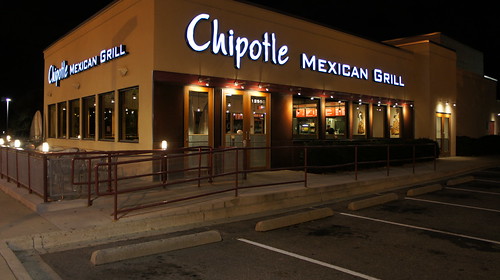
Exterior - Chipotle Mexican Grill
Photo taken by Aranami from his/her Flickr photostream

The second restaurant that we had problems with was Chipotle Mexican Grill.  The Chipotle chain has been touted as a good option for people with various food allergies.  The company's lists major allergens in each menu item on their website and proclaims that their food is completely egg-free, nut-free, shellfish-free and fish-free.  Dairy products are limited to the cheese and sour cream so, in theory, someone with a milk allergy could get a safe meal so long as proper care has been taken to prevent cross contamination.

We tried Chipotle as I had read a lot of positive reviews from other food allergy parents.  Sadly, it wasn't a good experience for us.  Ryken developed a stomach ache a few minutes into eating.  He claims he felt a little stomach ache before dinner but it was clear to us that his stomach ache intensified after he began eating.  We monitored his symptoms and kept our EpiPen Jr. packs close by while we rushed back to the hotel.  His stomach started feeling better after about half an hour from when we ate.  I can't say for certain what Ryken reacted to -- cross contamination of milk or maybe he has an undiagnosed allergy to a less common ingredient (maybe a spice) used in the cooking process?  All I know is that we had big hopes for being able to add another safe restaurant to our very short list but it was not meant to be.

I don't regret the decision to try eating out with the kids but I am very grateful the reactions were under control.  And despite those two incidents, we still had a fantastic time.  But I can't tell you the enormous sense of relief I felt to come back home -- forget sleeping in my own bed, I was relieved to cook our meals again in the safety of our milk-free, nut-free kitchen!   Phew.  I sure could use a vacation after the vacation.

Until we meet again, gorgeous San Diego beaches!

April 10, 2013

My Personal Mission: A Nuts Table in Every School

My 8-year-old has been going through a huge transition year that I was not fully prepared for.  I must admit I didn't see third grade as being such an important year in my food allergic child's life, and I've been caught off guard by some of the challenges he's been faced with at school.  There has been food-allergy associated teasing and bullying, resulting in a lot of hurt feelings and confidence issues.

One of the reasons why I loved his school to begin with was the Nuts Table.  No, not the No-Nuts Table.  The Nuts Table.  If kids choose to bring nuts to school in their lunches, they must sit at the Nuts Table.  Too bad our school only implements it from kindergarten through second grade, then it changes to a No-Nuts Table. And for us, this was the year the trouble began.  I've tried to speak to them about it, but alas, this is their policy.  Well, you know what they say.  Try, try again.

It doesn't take much to understand that our kids would rather be part of a team than on the bench.

If your child's school already has a No-Nuts Table, then they already have a table designated for a group of children.  Perfect.  With a little reeducation, our food allergic children can sit with the masses.  It is my personal mission to try to change as many No-Nuts Tables into Nuts Tables as possible, through forward-thinking allergy-conscious people, like you!

You probably don't need it spelled out for you, but here goes...the top six reasons why I love the Nuts Table:

1.  Like I said, all it takes is a table and a bit of education.  It's so easy to implement, it's almost a no-brainer.  There are a plethora of rules and procedures associated with the lunchroom anyway, all of which are necessary to keep it running smoothly and safely.  This is such an important one for our school communities, in order to lead by example and demonstrate inclusion at lunch time.

2.  Most food allergic children will experience a sense of isolation and teasing along the way; we don't need to exacerbate this divide by putting them at their own table at lunch, too.  It's heartbreaking to think that this divisiveness could be avoided.  A Nuts Table says to our food allergic children, "Hey, we want you to be safe, but not excluded."

3.  A No-Nuts Table punishes kids who have no choice about their food allergies, while a Nuts table empowers children who actually have a choice about what they eat to consider their food preferences more carefully.

4.  A Nuts Table confines nuts, residues, and crumbs to one table, thus making a more thorough and focused table cleaning possible, and resulting in less allergic reactions due to cross contamination.

5.  A No-Nuts Table gives lunchroom monitors a sense of false security when it comes to food allergies.  It assumes that the possibility of an allergic reaction is highly unlikely.  In reality, about a third of children with food allergies have multiple food allergies, which means that these children still need to vigilantly follow safe practices at the No-Nuts Table.

6.  The Nuts Table is a wonderful means for every child to educate her parents about food allergies and about making food choices that affect us all.  After all, the parents are the ones making the lunches, but the kids have a say in what they want for lunch.

I've read enough stories similar to my son's to know that the No-Nuts Table, although a good first attempt at keeping our food allergic children safe, is a bit outdated.  We can do better for our children.

Please read, pass this on to your school administrators, friends, and family.  And thank you for always being your children's greatest advocate!

March 25, 2013

A Successful Marin Overnight

When Tristan left in the morning with his big duffle filled with sleeping bag, toiletries, and layering pieces--for which I had specific instructions lest he go out everyday in a t-shirt--I was in pieces.  There was never a doubt in my mind that we would make it happen, and figure out a way for him to be included in his class' first overnight stay.  I just hadn't anticipated how nerve-wracking it would be.  And little did I know how much of a learning and growing experience it would be, for the both of us.

Eighty third graders stayed two nights at the Point Bonita YMCA.  It is a clean facility, with separate boys' and girls' dorms.  Bunks are divided into several smaller rooms and one meeting room, and large bathrooms.  Their spacious dining hall includes a buffet and plenty of long cafeteria-style tables.  All the children were given an orientation about how the dining hall works, with an emphasis on composting and taking only what you can eat.  The food is mostly organically grown and healthful, with basic ingredients, which simplified things for us.  On top of it all, the meals were delicious.


So how does a multiple and severely allergic child eat in a dining hall in a camp-style setting?  With a lot of planning, foresight, and a bunch of faith thrown in for good measure.  Richard Holden at Point Bonita YMCA was a pleasure to work with.  We communicated via email, with a follow-up discussion with his chef when we got there.  Here are a few things that worked for us:

1.  I emailed Food Service Director Rich Holden well in advance of the trip.  We emailed back and forth until I came up with a modified menu for Tristan.  It would have been nice for these menus to have been posted in the kitchen upon our arrival, but Tristan brought two copies of the menu with him, both of which he ended up giving to the chefs for reference.  I made sure to introduce Tristan to the chef before the first meal.

Here is the dinner menu for day 1.  Rich was willing to do a modified menu, or a combination of a modified menu and supplements, depending on the food allergies. We needed to do minimal supplementation (just soy milk boxes and Oreos), as there was lots of variety.

Point Bonita Sample Dinner Menu

Pasta and Meat Sauce
or Vegetarian Pasta
Sauteed Vegetables
Dinner Roll, Salad Bar
Fresh Baked Cookies

Tristan ate a hearty meal of pasta with meat sauce and vegetables on day 1.  His food was either separately plated by the chef, or he was allowed to plate his food first to avoid cross contamination at the buffet.  We brought a stash of Oreos for dessert, and he ate those instead of their cookies.  Although I was very impressed by the kitchen's attempt to accomodate Tristan with allergy-friendly cookies, I decided against them after reading a "traces of dairy" warning on the package.

2.  Before the trip, I gave Tristan's third grade team a refresher on food allergies and Epi-Pens.  I used some of the materials from our Food Allergy Summit in NY (and later improved the presentation with a food allergy quiz).  Each teacher tried out a trainer pen, and I answered everyone's questions as best as I could.  We agreed that Tristan would carry his Epi-pen in his pack.  It was really valuable to reconnect with the teachers about the severity of Tristan's allergies.  During his stay, Tristan was grouped with the male teacher in the group for hiking and bunking.  Big thanks to Mr. H and the third grade team!

3.  On the advice of his allergist, Tristan brought Claritin to take nightly.  In an unfamiliar place with allergens all around, it was smart to have some antihistamine in his system.

4.  The naturalists were alerted of kids who had special needs or medications, so they were made aware of Tristan's allergies and medications in his pack.

5.  I tried to prep Tristan about managing his food allergies with a balance of trust and caution.  I needed him to trust that I had prearranged a safe menu for him, but I also warned him that adults could make mistakes, and that he needed to make sure he was getting what was on his menu.  I asked him to look at his copy before each meal, and make sure he knew what he was supposed to be eating.  I think that helped empower him and give him a sense of confidence.

6.  I packed safe granola bars in his pack, in case he wasn't comfortable with a meal, snack, or just got hungry.

When I went to pick Tristan up from school on day 3, he looked relieved to see me. In the car, he told me that he "just missed us so much."  I was so proud of him for having such courage and stamina to collect his worries and gain such a valuable experience.  Three days without him at home gave me a glimpse into the future, with a bit of worry, but a lot of optimism, too.


The day I was there, we hiked around and down to the beach, then back to the Y. The kids would approach the trail as a group, each with different responses and ways of coping.  Some would charge straight down the hill, without looking back.  A few would sidestep down, cautiously taking each step.  Others would look straight down, as not to brush against poison oak, or step into a hole.


My hope for Tristan is that he is cautious, but confident through life, and that he take the time to explore and take in his surroundings.  I hope that when he needs to, he will grab my hand for some extra support, and that he will let go when he's ready.  I may never be ready, but knowing that he will be is an awesome feeling.

March 18, 2013

Epinephrine -- why some food-allergic people don't carry it and why they should

Just in the past week there have been two food-allergy related deaths reported in the news.  College freshman Cameron Groezinger Fitzpatrick died of anaphylaxis after eating a cookie made with peanut oil. 12-year-old Maia Santarelli fell ill and died of anaphylaxis after eating ice cream purchased in a shopping mall.  It breaks my heart every time I read the headline and see the photo of these smiling, vibrant faces.  These young people had their whole lives ahead of them but they cut way too short, and all because of food.

When I read these stories, I think of my own kids with food allergies.  How can I not?  Have I given my kids a cookie that I was told was free of milk and free of nuts, only to discover that this was not true?  Yes.  Did my youngest eat ice cream in the mall, develop facial swelling, sneeze, and cough, and require a visit to the ER?  Yes.  These accidents happened.  I am not proud of that fact that they happened under my watch but I have accepted that accidents are accidents.  I try my best to prevent them but mistakes are always made.

I have met more food allergy parents (lucky for the camaraderie, unlucky for having allergies, too) lately.  Most of the time I have been shocked to hear that many did not have a food allergy action plan in place and did not routinely carry epinephrine auto-injectors or store them at school sites.  After talking with these parents -- and strongly urging them to keep epinephrine close at *all* times regardless of their history of reactions without trying to sound judgy -- I started to wonder why so many parents don't keep life-saving medication handy.  Based on my conversations and my own evolution as a food-allergy mom, I came up with this reasons:


"My child's allergies aren't too bad.  She isn't that allergic, like other kids." 
There is an idea that allergy testing and patterns of previous allergic reactions can predict how a person will react when exposed to a known allergen.  However, this is a serious misconception.  Allergic reactions may be different in any given situation.  A hive after one instance of exposure could be abdominal cramps and vomit in one situation, or swelling airways in another.  No one knows the type and severity of a future reaction and for that very reason it is critical to always prepare for the worst-possible reaction by carrying epinephrine medication with you at all times.

San Jose father Brian Hom lost his older son, BJ, to food allergies after an accidental exposure to peanuts.  In this FARE public service video, Brian describes the mild reactions that BJ had prior to the reaction that took his life.


Yes, it is responsible -- critical -- for all families who manage food allergies to try to be in control or have full knowledge of any food or skin products that they will come in contact with.  (Good practice for non-allergic families, too!)  But mistakes happen to even the most diligent of us.  Epinephrine provides a line of defense for those mistakes.  Having epinephrine does not mean you can take risks and neglect talking to food preparers, reading ingredient labels, and asking about possible cross contamination.  And having epinephrine as a backup does not mean you or others should view yourself as unable to protect your child through your judgment.

We are extremely careful about what our family eats, too.  But just recently both kids have an allergic reaction to cupcakes made from the same recipe and bakery that they have had two times before.  We gave the kids Benadryl, kept our EpiPens at the ready, and watched them like hawks and the symptoms gradually subsided.  Unless you grow all the ingredients and make and handle the foods yourself, you just never can be 100% sure of the safety of your food.


"It's so bulky but we carry Benadryl."
While I don't think people want to admit it, size does matter for some.   An EpiPen auto-injector does take up quite a bit of room especially when you have more than one food-allergic child!  Pair the bulky excuse with "my child isn't that allergic" or "we are very careful about what s/he eats," and parents can convince themselves that it's okay not to take their auto-injectors with them.  Benadryl may be good for mild symptoms like rashes and sneezing but it is not enough to keep airways open in the case of anaphylaxis.

If size is an issue, a new epinephrine auto-injector may be a more attractive option for you.  Sanofi's "Auvi-Q" auto-injector has just come out on the market.  Auvi-Q provides emergency epinephrine medication in the size of a credit card.  The devide also features voice instructions that can walk whoever must administer the medication through a potentially new and stressful situation.  My allergist demonstrated the device for us at our last appointment in January.  While the brand new product does not have a track record yet, the size and voice-guided commands are definitely attractive.


"I keep forgetting to pack it." 
Packing an epinephrine auto-injector may not be part of your daily routine already but it should be.  I have a mental checklist of exactly 4 things that I absolutely do not leave the house without: keys, wallet, phone, and Epi-Pen Jr. twin-packs for each child.  My husband and I have turned the car around several times when we realized that we had forgotten to grab our emergency medication pack as we rushed to get out the door.  It is a lifeline and, however cumbersome it is, you just have to learn to remember it always.


"We're not going far." 
Allergic reactions can happen instantaneously anywhere, even in areas that you frequent and consider your safe zones.  In the case of anaphylaxis and the swelling of airways, every minute counts.  Epinephrine is most effective at the onset of a serious reaction.  Delayed use of epinephrine can still lead to death.


"We're not planning to eat anything while we're out." 
This is a good game plan for parents.  But sometimes there are unexpected delays or last-minute changes of plans that make it necessary to feed your kids.  Whether it's store-bought, restaurant-prepped, or homemade food, any time your child will ingest something it is important to be prepared for a reaction in case there was cross contamination anywhere in the food manufacturing, preparation, and serving process.  

Even if you aren't eating anything, allergic reactions can occur with non-food items.  More and more hair and skin products are using ingredients such as food proteins, nut oils, and extracts.  I can think of four occasions when my kids and I read the label of a liquid soap at a restaurant, a friend's house, even the allergist's office (true story) and discovered it contained milk protein or walnut oil.


Bottom line: Any food allergy has the potential to be life-threatening.

Studies have shown that a body's reaction to one exposure may be very different from the body's reaction to another exposure: you just don't know.  When someone you know and care for has food allergies, your life will and must change.  You must toss out your idea of a totally carefree and spontaneous life and be prepared with safe foods, wipes for cleaning hands and surfaces to limit cross contact, and emergency life-saving medication.  People with food allergies can still lead happy, healthy lives -- our kids certainly do -- but it is not without constant vigilance, planning, and clear communication.  Think of it as a "new normal" and keep yourself ready for any situation.

March 14, 2013

Kale Mint Chip Ice Cream revisited -- dairy-free, soy-free goodness

St. Patrick's Day is this Sunday.  Do you celebrate it in a big or small way with your family?

My family has no Irish roots but we do use the holiday as a fun way to "get our green on".  I have been on a kale kick lately -- kale in our tacos, kale in our fried rice, kale in our pasta-- so I definitely want to make something with this vitamin-rich leafy green.

With warm temperatures arriving in our area, it was a great excuse to break out the ice cream maker.  I decided to revisit a kale mint chip ice cream recipe I had posted in 2011.  I love to tweak and remember having some issues with the texture of the frozen ice cream so I went right to tinkering with the original recipe.


I subbed in agave sweetener for the refined sugar so that I wouldn't need to heat the mix to dissolve table sugar.  I ended up reducing the amount of agave because it is sweeter than table sugar.  I omitted the extra oil that the original recipe called for since canned full-fat coconut milk provides enough fat to help with the creamy texture.  Adding arrowroot powder is absolutely key to getting a creamy texture.  It is expensive stuff but a little goes a long way -- the same bag of stuff will get you through many, many quarts of smooth ice cream, my friends.

I think it also helped tremendously to be working with a better blender (we have a Ninja) that could really grind up the kale leaves into tiny pieces.  The more the kale is ground up, the easier it is to hide any chewy leafiness among the mini chocolate chips!  And mini chips were much more appropriate in frozen dessert than regular-sized chips.  I love that Enjoy Life offers this size.


Kale Mint Chip - free of the top 8 allergens depending on the type of milk substitute you use

4 cups of packed curly kale leaves (stems removed), washed and dried
15 oz can of full-fat coconut milk
2 cups safe, milk substitute (I used almond milk but soy, rice, flax, or coconut milk should be fine)
1/3 cup agave sweetener
2 Tbsp arrowroot powder
1 tsp vanilla
1 tsp mint extract
dash of sea salt

1/2 cup Enjoy Life mini-chocolate chips
  1. Except for the mini-chocolate chips, combine all ice cream ingredients in a blender.  Blend until kale leaves are cut into tiny flecks.
  2. Prepare ice cream mixture (again, not the mini chips yet) according to your ice cream maker's directions.  Add the mini chips in at the last five minutes of the ice cream making time.
  3. Serve immediately.  The ice cream will be a little more solid than soft serve.  Freeze for an additional hour for a more ice-cream-out-of-a-carton texture.
  4. Freeze any leftovers in a freeze-safe container.  When serving on another day, let the ice cream container warm up on the counter (room temperature) for 30-45 minutes before scooping.
I completely misjudged how much ice cream to give the kids.  But they
sure enjoyed every last lick of their humungous cones!

The texture is a big improvement over the original posted recipe.  My eldest son, who had not been a fan of the 2011 kale ice cream, absolutely loves this new iteration as does his little brother.

March 12, 2013

Product Review: Trader Joe's Vegan Mozzarella Shreds

I was shopping at my neighborhood Trader Joe's yesterday when, what did my wandering eyes see?

Oh yes.  It's finally here.

I had hoped and asked through the company's online product comment form for Trader Joe's to start carrying vegan cheese.  (I hoped that other like-minded folks were doing the same from their home computers, too!)  Now, I realize that there is already an excellent vegan cheese substitute on the market.  I don't think it would be exaggerating if I said that Daiya has revolutionized the vegan and allergic worlds with its completely milk-free, top 8-free cheese substitutes.  It tastes great and it melts.  In my inquiries to Trader Joe's about vegan cheese, I specifically mentioned Daiya by name as a product that the company should consider offering.

This winter Trader Joe's finally started selling vegan cheese and, of course, took it one step further: they are selling vegan cheese until their own label.  I found Trader Joe's vegan mozzarella shreds selling for $3.29 for an 8-oz bag.  This is significantly less than the $5 that I pay for packs of Daiya.

General observations about TJ's shreds:  The shreds are thinner, drier, and more translucent than Daiya shreds.  They kind of reminded me of parmesan shreds.  TJ's mozzarella shreds come in a convenient resealable package, an improvement over Daiya's packaging.  To me at least, TJ's shreds smelled like real cheese when I first opened the package, so much so that I momentarily got a little nervous about serving it to my kids.  (I admit, I reread the ingredients after the smell check!)  I mention the scent because I have read that some people really do not like the smell of uncooked Daiya.

I decided to test-drive TJ's shreds on some homemade pizza.  I made a barbecue pizza and a sauceless vegetable pizza using Trader Joe's fresh, whole wheat pizza dough.  If your family is okay with wheat and gluten, TJ's pizza dough is a great option for tasty, thin crust pizza.  I baked the pizzas according to the dough directions.  I took the pizzas out when the crusts were golden around the edges at around 11 minutes.

TJ's shreds melted completely.  They melted well -- almost too well -- it was hard to tell that there was vegan cheese on the pizza.  It was definitely on the gooey side taking on a sheen like glazed donuts.  It would be nice to have a more whitish look to the cheese like real mozzarella but what I really cared about was the taste.  Would it be a worthy substitute for the real thing?

TJ's shreds were pretty good. They had a nice flavor that tasted more like the real thing to me than Daiya.  After my second time of making pizza with TJ's shreds, I did detect a slight powdery aftertaste.  I'd say texture-wise, TJ's shreds are on one end of the spectrum and Daiya is on the other, with real mozzarella shreds right in the middle.  Daiya melts and stretches to a point but not as readily as real cheese.  TJ's shreds melt more than real cheese would.  Beyond taste and texture I was ecstatic to see that TJ's vegan shreds are fortified with calcium.  They provide 25% of the RDA for calcium per 1 oz (about 1/4 cup) serving.  Daiya Vegan Shreds provide a mere 2% of the RDA for calcium.

Trader Joe's vegan mozzarella shreds will definitely be a regular in our carts!
With a very good taste, meltability, calcium-richness, and competitive pricing, I definitely recommend Trader Joe's vegan shreds to anyone who is looking for a milk-free mozzarella substitute.  Daiya's growing product line (including vegan pepperjack and cheddar shreds, wedges, and spreads) is still a lifeline for cheese-longing vegans and individuals with milk allergies.  I do love their products but I will now buy my mozzarella shreds exclusively from Trader Joe's.  What's more, I hope my frequent purchases will keep vegan shreds on the shelf and encourage Trader Joe's to expand their vegan cheese products to more flavors.

March 4, 2013

A Food Allergic Kid's First Overnight Camp--Anxiety, Bravery, & Responsibility

Sleep training, weaning, and a slew of uncertain firsts--first day of preschool, first cavity filled, first vaccinations, first fever, first fall, first time being teased or belittled.  Anyone who thinks parenthood is easy has never been a parent.

Our kids go from us being there every step of the way to independence in what seems to be a blink of an eye.
Tristan had his first fashion photo shoot at 10 months old. 
I was there to push him in the swing, and to take him out when he started crying.
It's been a long time since he got all of our undivided attention.
On top of these gut-wrenching rituals into childhood, our kids today deal with much higher expectations than we could've ever imagined when we were little.  At issue in our household: pressure for excellence in schools with curricula that is increasingly demanding, in a pool of students who are exposed to academic learning at earlier ages.  Then, the need to book our children's schedules with enrichment activities to keep them well-rounded.  On top of this, kids need to be able to negotiate the delicate balance of fitting in, which is essential for surviving in school, while keeping the uniqueness that comes from inside them.  Having food allergies means being "unique" is inherent, making kids work even harder to find that balance.

Tristan's love of performing has made him a target of teasing.
Being eight is a difficult business.  Being eight with food allergies and facing your first three-day overnight with 88 other children and a chef you are entrusting your life with seems daunting.  Being the parent of said child is filling me dread.

I pride myself in not being the worrying type.  But third grade has brought with it new challenges that I may not have readied myself for, nor did I adequately prepare my son for.  And I'm worried.

This week, he will be venturing out into the world with another first.  A first that has taken much preparation, physically and emotionally.  His anxiety has rubbed off on me, and mine on his.  For a kid who has always dived into life's challenges, the vulnerability I've seen over recent issues has required us to grow--to be more open, to listen to each other more, and to reassure each other.  Growing has meant rough patches, disagreements, and misunderstandings, but like with any other milestone, after this experience, both of us will come out different people--for the better.  If anything, he'll learn to toughen up and I'll get better at holding back the tears.


Menu planning, lots of emails back and forth, a meeting with his allergist, a teacher training on Epi-pens and anaphylaxis, and lots and lots of worrying has gotten us to this point.  I don't usually ask for much, but this week I'm asking you to please keep our family in your thoughts, especially my brave boy, who will this week take on the greatest responsibility of his life thus far.